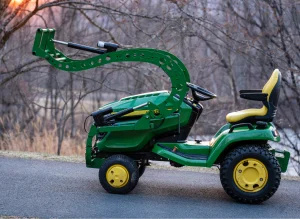


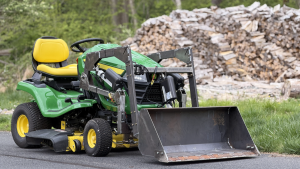
A front loader can be added to certain heavy-duty garden tractors, but standard lawn tractors usually lack the frame strength, axle capacity, and transmission durability needed to handle the added load safely. Before installing a loader, owners should verify structural rigidity, front axle strength, transaxle capability, rear ballast, electrical output, and overall attachment compatibility to reduce the risk of equipment damage or tipping. When properly matched to the tractor, electric, hydraulic, or mechanical loader attachments can make tasks such as moving mulch, soil, compost, firewood, and light snow much easier and more efficient.
Staring at a huge pile of topsoil in the driveway, then looking at the riding mower sitting in the garage, you naturally wonder if there’s a way to cheat the system. Moving three yards of dirt by hand with a rusty wheelbarrow is a guaranteed way to ruin your entire weekend and wake up sore on Monday.
Slapping a bucket on the front of your mower seems like the perfect, cost-effective hack to save your back and get the job done in half the time. After all, it has an engine and four wheels, so why shouldn’t it work like a real tractor?
But here is the brutal truth that most hardware store salesmen won’t tell you: doing this wrong will permanently destroy your machine. Bolting a loader onto a residential riding mower without understanding the physics of chassis strength, front axle weight ratings, and transaxle heat limitations is a recipe for disaster.
You can literally snap the frame in half or blow the transmission in a single afternoon. To definitively answer the question, can you put a front loader on a lawn tractor? Let’s break down the actual engineering, compatibility rules, and safe attachment options so you can upgrade your equipment confidently without ruining a perfectly good mower in the process.
Quick Answer: Yes, you can install a front loader or powered bucket on specific garden tractors. The machine must possess a heavy-gauge steel frame (10 to 12 gauge), a cast-iron front axle, and a heavy-duty transaxle like a Tuff Torq K66 or better. Standard entry-level mowers will literally break under the stress. Properly rated tractors safely run electric or hydraulic loaders when utilizing correct rear ballast.
Using “lawn tractor” and “garden tractor” interchangeably is a big mistake. To the untrained eye, they look identical. Underneath the plastic hood, the engineering is completely different.
Your standard box-store mower rides on 12-to-14 gauge stamped steel. Manufacturers engineer this thin metal strictly to carry a driver across flat grass. Introduce dynamic lifting conditions, and that thin steel twists. We’ve seen frames snap completely in half after a homeowner tried moving gravel. Real garden tractors utilize heavy welded channel steel to resist this exact twisting torque.
Carrying heavy payloads across uneven terrain transfers immense pressure straight down into the front spindles. Standard stamped steel or aluminum axles shear right off under that kind of stress. To move earth safely, forged cast-iron axles with greasable spindles are a requirement.
Most DIY projects fail right here. Entry-level transaxles cannot handle heavy pushing. When you drive a bucket into a pile of dirt, the fluid inside a Tuff Torq K46 heats up incredibly fast. Past 180°F, it breaks down and causes permanent internal scoring. For the deep technical thermal data, check our lawn tractor transmission longevity guide. You need a ground-engaging unit with a built-in charge pump to survive earth-moving tasks.
| Specification | Standard Lawn Tractor | Heavy Garden Tractor |
| Frame | 12-to-14 Gauge Stamped | Heavy Welded Channel |
| Axle | Light Stamped Steel | Forged Cast Iron |
| Transmission | Tuff Torq K46 | Tuff Torq K72 |
| Compatibility | Micro Bucket Only | True Front End Loader |
| Capacity | 50–100 lbs | 350–500+ lbs |
Before buying any parts, you must verify your exact chassis. Our John Deere X300 vs X500 attachment compatibility breakdown shows how wildly different two similar-looking machines actually are under the hood.
Not all buckets are built the same. You have three main options depending on your equipment and budget.
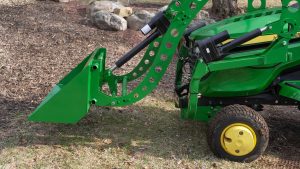
These require an onboard hydraulic charge pump. You get serious capability, with lift heights hitting 72 inches and payloads around 500 pounds. These remain the gold standard heavy-duty garden tractor attachments for people who essentially want sub-compact performance without buying a completely new rig.
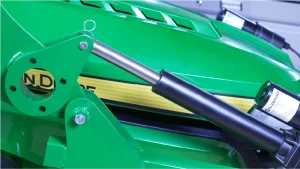
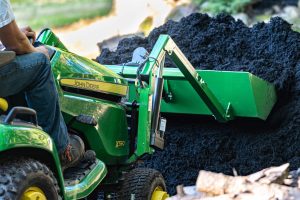
This is the sweet spot for most homeowners. Instead of dealing with messy fluid lines and complex pumps, these utilize linear actuators wired straight into your battery. DIY installation is incredibly simple. Check out the available electric linear actuator loader kits to bridge the gap between a wheelbarrow and heavy machinery.
Old-school and strictly manual. You pull a lever from the seat to dump the load. They are meant purely for skimming topsoil on lighter machines, and lifting capacity is limited entirely by your own arm strength.
Even if your tractor has the right transmission, you need to check these four boxes before hooking anything up.
You cannot just bolt a loader to the front bumper. The stress will tear the metal right out. Proper loaders use a subframe system that bolts along the chassis back to the rear axle, distributing those lifting forces evenly across the whole machine.
Short tractors get incredibly tippy. A longer wheelbase keeps things planted on the ground. Lifting weight shifts your center of gravity drastically forward, making slopes highly dangerous on compact machines. Keep it on flat ground.
This is a non-negotiable safety rule. The front axle acts as a fulcrum. We were running a rig at a property last year, and without rear ballast, the steering became impossibly heavy. Adding suitcase weights fixed it instantly. Run your specific payload numbers through our counterweight and rear ballast calculator to get the physics right.
Electric actuators demand real power. Repeated dumping cycles drain batteries fast. Verify your alternator produces a 15 to 20 amp charging output to prevent killing the battery mid-project.
Let’s talk about what these attachments actually handle out in the yard.
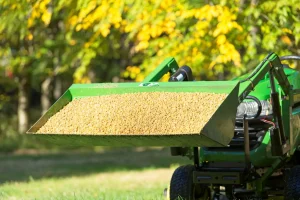
They are lifesavers for transporting loose mulch, turning large compost piles, and moving loose soil. In winter, clearing slush from paved drives is a breeze. They also excel at relocating split firewood across a large property.
Do not try to dig into undisturbed hardpack clay. Stay away from mature tree roots, and never try prying up heavy concrete slabs that exceed your equipment’s static ratings. It’s a tractor, not an excavator.
Upgrading a mower with material-handling gear requires a delicate balance of engineering. It means managing shear stress, calculating ballast, and keeping transaxles alive. At LGM USA LLC, our equipment specialists spend years pushing these machines to their limits in the field. We understand real-world property maintenance because we actually do it. Our goal is to provide precision-compatible systems that actually work without snapping frames. Relying on our technical guides means getting straight answers on ballast safety, strict mechanical tolerances, and durable American-made components. We don’t guess on compatibility.
Let’s look at the actual math.
Buying a new sub-compact tractor costs between $18,000 and $24,000. Even a heavily used one runs $9,000 to $14,000. Meanwhile, an aftermarket loader kit lands between $1,500 and $3,500. If you already own a heavy-duty garden tractor, retrofitting is financially brilliant. If you pay a landscape crew $600 a year just to spread mulch, a bolt-on kit pays for itself in less than three seasons. The ROI is immediate, especially when factoring in the physical toll of yard work.
Grab a flashlight and do this quick 5-minute pre-purchase inspection:
Q. Can you put a front loader on any lawn tractor?
A. Absolutely not. Standard riding mowers have lightweight stamped frames and entry-level transmissions. A loaded bucket will crack the chassis or burn up the transaxle instantly.
Q. What size lawn tractor is needed to handle a front loader?
A. You want a machine built on a 10-to-12-gauge ladder frame weighing at least 600 pounds bare, featuring a cast-iron axle, 20+ horsepower, and a ground-engaging transmission.
Q. How much weight can a lawn tractor loader safely lift?
A. Mid-size rigs equipped with electric scoops handle 150 to 250 pounds safely. A heavy garden tractor utilizing a true front-end loader can lift 400 to 500 pounds.
Q. Do lawn tractor front loaders require an onboard hydraulic system?
A. Not anymore. Many modern residential kits use heavy-duty 12-volt linear actuators wired directly to the battery, eliminating the hassle of hydraulic hoses entirely.
Q. Can John Deere lawn tractors use front-end loaders?
A. Entry-level mowers like the D100 series cannot. However, their heavier Multi-Terrain garden tractors, like the X300, X500, and X700 series, take specialized aftermarket loaders brilliantly.
Q. Why is rear ballast mandatory when using a tractor loader?
A. Physics. The tractor acts exactly like a seesaw. If you don’t hang heavy suitcase weights on the back, you lose steering traction and risk rolling forward.
Q. What is the difference between a lawn tractor and a garden tractor for attachments?
A. Lawn tractors just cut grass. Garden tractors have bigger tires, heavy channel-steel frames, and rugged transaxles built to handle ground plows and front buckets.
Q. Can you install a front bucket loader yourself at home?
A. Yes. Most electric power buckets are bolt-on accessories utilizing factory mounting holes. With basic hand tools, you can easily finish the job in a few hours.
Q. Will adding a front loader void my lawn tractor’s warranty?
A. Usually, yes. Unless it is an OEM-approved attachment for a heavy-duty model, snapping an axle on a light-duty mower guarantees a denied warranty claim.
Q. How much does it cost to add a front loader to a garden tractor?
A. Basic electric scoop kits run $1,200 to $2,200. A complete mini front-end loader with full lifting arms and heavy actuators costs anywhere between $2,500 and $4,500.
Turning your machine into a dedicated material handler saves time, money, and your back. Just respect the engineering. Verify your frame gauge, confirm that transaxle rating, and never skip the rear counterbalance weights. If your rig meets the specs, an aftermarket loader will completely revolutionize your weekend yard work. Get out there, check your manual, and start building a better machine.

© 2026 All Rights Reserved | LGM USA LLC
Added to cart
Check out our shop to see what's available