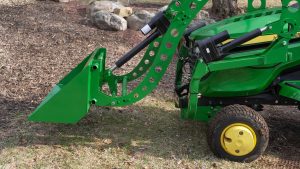

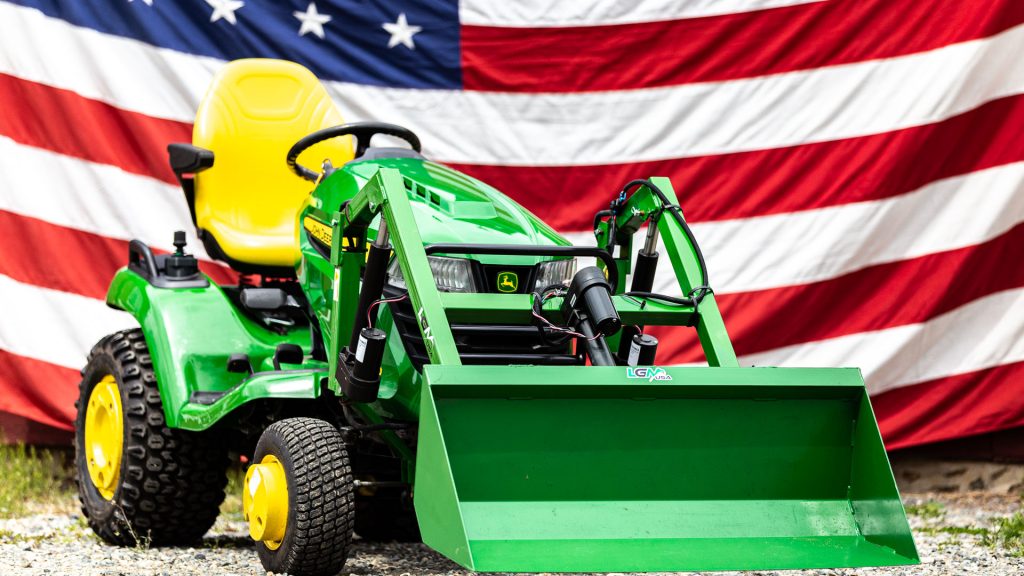
Front-end loaders play a central role in modern small-property maintenance, landscaping, light farming, and general material handling. They move, lift, dig, shape, and grade — transforming compact tractors into versatile, high-value equipment. As technology evolves, one question has steadily divided tractor owners:
Both accomplish similar tasks, but their engineering, operation, upkeep requirements, and long-term ownership experience differ significantly. If you own, or are looking to purchase, a compact tractor such as a John Deere X300 or X500 series model, understanding these differences is essential.
This guide breaks down how each system works, how they compare, and which type may be the most suitable choice for your needs.
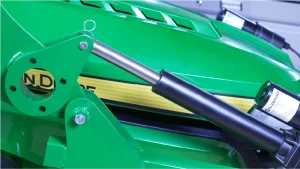
Electric front-end loaders represent a newer generation of tractor attachments. Instead of using fluid power, they rely on electric linear actuators to lift and tilt the bucket.
These actuators convert the rotational motion of an electric motor into precise, controlled linear movement — a direct push-and-pull action. The actuators are powered by the tractor’s 12-volt battery and controlled through a simple joystick or rocker switch positioned near the operator’s seat.
When you engage the controls, electrical current flows to the actuators. Inside each actuator, ball screws rotate and drive a piston forward or backward. This motion raises, lowers, or tilts the bucket smoothly and with impressive strength.
A well-designed electric loader like the LGM-100 can match or nearly match the lift speeds of small hydraulic systems, raising a 350-pound load in under seven seconds. Its major advantage is simplicity: no pumps, hoses, valves, or hydraulic fluid — just clean, direct electric power.
With no hydraulic oil to manage, electric loaders demand very little maintenance. Their quiet operation also makes them ideal for early-morning or late-evening work.
Hydraulic front-end loaders have been the industry standard for decades. They operate using fluid power, converting pressurized hydraulic oil into mechanical motion.
A hydraulic pump — driven by the tractor’s engine — circulates oil through hoses to the loader’s cylinders. Inside each cylinder, the fluid pushes a piston that extends or retracts to lift or tilt the bucket.
The operator controls this process using hydraulic valves, typically through a multi-directional joystick. Hydraulics deliver a familiar feel: strong, fast, and continuous. Because hydraulic systems routinely operate at pressures exceeding 2,000 psi, they provide exceptional lifting capacity suited for full-size tractors and commercial workloads.
However, that performance comes with complexity. Hydraulic systems require routine fluid checks, filter changes, and inspection for leaks. Cold temperatures also thicken hydraulic oil, leading to slow or uneven response.
In heavy machinery and commercial agriculture, hydraulics remain essential. But for small garden tractors or homeowner use, the complexity can feel excessive compared to the actual workload.
|
Feature |
Electric Loader |
Hydraulic Loader |
|
Power Source |
12-volt battery (electric actuators) |
Engine-driven hydraulic pump |
|
Maintenance |
Very low — no hydraulic fluid or filters |
Higher — requires fluid, filters, seals |
|
Noise Level |
Quiet operation |
Noticeably louder |
|
Ease of Installation |
Straightforward wiring setup |
Requires hoses, pump lines, fittings |
|
Lifting Speed |
Comparable to hydraulics; slightly slower under full load |
Fast and continuous |
|
Precision Control |
Exceptional accuracy with electronic joystick |
Very responsive, familiar hydraulic feel |
|
Operating Cost |
Low — no consumables |
Moderate to high |
|
Durability |
Excellent for light-to-medium work |
Excellent for heavy-duty use |
|
Cold Weather Performance |
Consistent; no oil thickening |
Slower response in cold temperatures |
|
Environmental Impact |
Clean operation — no oil leaks |
Potential for fluid spills and contamination |
Bottom line: Electric loaders excel in simplicity, reliability, and ease of ownership. Hydraulic loaders dominate in pure power and long-duration commercial use.
Pros
Cons
Pros and Cons of Hydraulic Front-End Loaders
Pros
Cons
Your choice depends entirely on how and how often you plan to use your tractor.
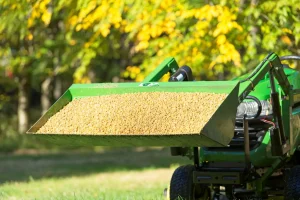
If you’re a homeowner, hobby farmer, or DIY landscaper, an electric front-end loader is likely the most practical decision. It handles soil, mulch, gravel, snow, and other everyday materials without the maintenance demands of a hydraulic system. You also get quieter operation and faster installation.
Electric loaders such as the LGM-100 fit directly onto John Deere X300 and X500 series tractors, draw power from the existing battery, and offer dependable daily performance.
If your work involves commercial agriculture, construction, or routine heavy lifting, a hydraulic loader remains the stronger choice. Its ability to operate continuously under high pressure makes it essential for larger tractors and industrial workloads.
Both electric and hydraulic front-end loaders have a well-earned place in today’s tractor landscape. The key is choosing the system that aligns with your workload, operating style, and long-term expectations.
If you value easy setup, low maintenance, and clean, quiet performance, electric loaders such as the LGM-100 are redefining what small tractors can do. They produce impressive lifting power without the complications of oil, pumps, or extensive servicing. For homeowners, hobby farms, and landscaping projects, they offer a modern, intuitive experience.
If your work demands relentless strength, heavy lifting, and full-day operation, hydraulic loaders still lead the field. Their power, speed, and consistency make them indispensable for intense agricultural and industrial use.
The LGM-100 Front-End Loader strikes a unique balance of durability, capability, and simplicity. It is tough, efficient, and powerful for its class — yet easy enough for almost anyone to install and operate. Whether you’re moving mulch, clearing snow, or reshaping your land, it transforms routine tasks into productive, satisfying work.
You don’t need professional training to achieve professional results.
You simply need the right equipment.
If you’re ready to unlock the full potential of your John Deere tractor…
If you want to lift more, move smarter, and work cleaner…
Then it may be time to choose a new direction.
Choose the LGM-100.
Lift it. Move it. Get it done.
Yes. Modern electric loaders use high-grade linear actuators engineered for repeat lifting under consistent load. Models like the LGM-100 can repeatedly lift up to 350 pounds with no decline in speed or precision. For residential and light commercial use, electric loaders have proven extremely dependable with minimal maintenance.
Hydraulics historically held the speed advantage, but electric technology has closed much of that gap. Advanced electric actuators can now deliver full lift in under seven seconds — nearly identical to compact hydraulic systems. For typical property maintenance tasks, the difference is negligible.
No. Electric loaders draw power only during movement. Because most loader movements are short bursts, a healthy 12-volt tractor battery can provide hours of operation. For longer sessions, a basic battery monitor or trickle charger provides added convenience.
It depends on the use case. Hydraulics are powerful and durable but require ongoing costs for fluid, filters, and potential repairs. Electric loaders have fewer wear points and much lower operating expenses, making them a strong long-term investment for homeowners and small-scale users.
Technically possible — but rarely practical. Electric loaders are engineered from the frame outward for actuator-based operation. Converting a hydraulic loader would require relocating mounting points, replacing cylinders, and redesigning the control system. In most cases, purchasing a dedicated electric loader is more cost-effective.

© 2026 All Rights Reserved | LGM USA LLC
Added to cart
Check out our shop to see what's available