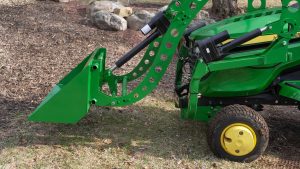


You know that feeling. It feels like Christmas morning, only better, because you are an adult who just installed a front-end loader on a garden tractor. You stand in the driveway with a cup of coffee, looking at a pile of mulch or a gravel driveway that needs attention, and the thought hits you that a lot of physical strain just disappeared.
That feeling holds true. A front-end loader truly changes the way work gets done.
After more than two decades in this industry and firsthand exposure to countless close calls, bent frames, and avoidable mishaps, an honest conversation matters. When garden tractor front end loader attachments are installed, the tractor becomes a very different machine. Balance, weight transfer, and overall behavior change immediately.
Most owners focus on lift capacity and bucket width because those numbers feel exciting. Real safety and long-term durability come from understanding the quieter details found deep inside owner manuals and operator guides.
This guide focuses on real world safety essentials that experienced operators recognize through years of use.
Picture a freshly installed LGM 100 mounted on a John Deere. A full bucket of wet topsoil lifts smoothly. Power feels effortless. When backing up, rear tires spin or the back of the tractor feels unusually light.
This scenario represents the most common issue seen with a garden tractor front end loader.
Garden tractors were engineered primarily for pulling and towing. Lifting hundreds of pounds several feet forward shifts the tractor into a seesaw effect. The front axle becomes the pivot point. Weight added to the bucket requires an appropriate counterbalance at the rear.
Light materials may feel manageable at first. Heavier loads such as rocks or logs reveal the reality of weight transfer very quickly.
Ballast functions as a foundational requirement rather than an optional add on. Wheel weights, rear mounted weight brackets, and liquid filled tires all provide effective counterweight. Many owners across the United States prefer beet juice based tire ballast because it offers excellent weight density while protecting wheels from corrosion.
Proper ballast improves traction, protects the front axle, and creates a stable working platform that feels controlled and predictable.
Tire pressure receives little attention during routine mowing. Loader work changes that completely.
With a front end loader attached, front tires support the engine, loader frame, and load material. Soft tires allow excessive sidewall flex, which reduces stability during turning and increases the likelihood of tire bead issues.
A tractor with properly inflated tires feels firm and responsive rather than loose or unpredictable.
Front tires perform best when inflated to the maximum pressure listed on the sidewall during loader operation. Rear tire pressure also plays a role in maintaining overall balance and traction.
A loader introduces a new visual profile. The bucket creates a blind spot directly ahead of the tractor that did not exist before installation.
Tight maneuvering around garages, fences, and landscaping features requires an awareness of how far the bucket extends and how wide it swings during turns. Many property owners discover this only after unintended contact with fixed objects.
Operating with the bucket positioned low enough to maintain forward visibility helps with precision work. Lowering the bucket before parking in enclosed spaces adds an extra margin of safety and protects surrounding structures.
Raising a loader increases the tractor’s center of gravity. A tractor that feels stable with the bucket lowered behaves very differently when the bucket rises.
Even minor surface irregularities such as holes or ruts can create sudden weight shifts when the load is elevated. Real world experience shows that controlled movement keeps operations smooth and predictable.
Loads perform best when carried just above ground level. Lifting takes place only when the tractor remains stationary and positioned for dumping. Slower speeds support better balance and allow the operator time to react.
Many residential properties feature slopes rather than flat terrain. Loader operation amplifies the importance of slope awareness.
Driving across a slope introduces lateral weight transfer. Descending slopes with a full bucket increases forward weight shift and affects steering response.
Backing down slopes with a loaded bucket places the tractor’s weight uphill and improves control. When forward travel becomes necessary, reduced speed and a low bucket position help maintain stability.
Electric front end loader systems such as the LGM 100 provide quiet, clean operation suited for residential use. These systems excel at controlled lifting.
Rapid impacts create shock loads that transfer force into mounting points, frames, and pivots. Garden tractors perform best when the loader functions like a precision tool rather than an impact device.
Gradual engagement with material allows the actuators to perform the lifting. Breaking hard ground before loading reduces stress on both the loader and tractor.
Cold weather introduces new variables. Snow piles freeze solid overnight. Traction changes significantly on paved surfaces. Objects hidden beneath snow remain unseen.
Snow removal requires a slower, more deliberate approach than summer material handling.
Familiarizing oneself with the work area before snowfall helps prevent surprises. Working within known clear zones improves safety and equipment longevity.
Skill improves with experience. Smooth control and confidence develop naturally. Awareness and routine checks remain essential as familiarity grows.
Simple habits such as seatbelt use, pre operation inspections, and maintaining clear surroundings support consistent safe operation.
Checking surroundings, confirming secure mounting hardware, and maintaining focused attention create a strong foundation for safe use.
Electric loader systems eliminate high pressure hydraulic exposure. The lift capacity remains well matched to common John Deere X300 and X500 garden tractors. This balance allows meaningful work while staying within the design limits of residential equipment.
A front end loader transforms weekend chores into efficient, satisfying work. Tasks that once required hours now take minutes with far less physical strain.
Understanding balance, maintaining proper ballast, monitoring tire pressure, and operating with awareness ensure that the loader remains a valuable long term investment.
With thoughtful operation, a garden tractor front end loader becomes one of the most practical tools on any property.
Maintaining a low bucket height while moving is one of the most important safety practices for garden tractor operators. Carrying a heavy load high raises the machine’s center of gravity, increasing the risk of tipping, especially during turns or uneven terrain.
Garden tractors have a narrower wheelbase than commercial equipment, making them more unstable on inclines. A loaded bucket shifts weight distribution and can cause loss of traction or rollover risk on slopes.
A full loader bucket shifts weight forward and can reduce rear traction and steering control. Adding rear ballast such as suitcase weights or a ballast box restores balance and keeps rear tires firmly grounded.
Operators must avoid exceeding the tractor’s rated front-axle capacity. Overloading heavy materials like wet gravel or stone can strain spindles, bushings, and tires, potentially leading to mechanical failure.
A front-end loader increases the tractor’s size and creates blind spots and a larger swing radius. Operators should always check surroundings for obstacles and keep the bucket lowered when parked to improve safety.


© 2026 All Rights Reserved | LGM USA LLC
Added to cart
Check out our shop to see what's available