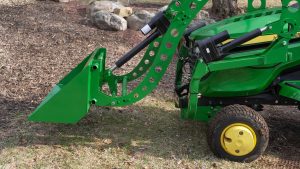


If you own property with acreage, you know the specific strain that comes from moving mulch, gravel, or topsoil by hand. You have likely looked at your John Deere sitting in the garage and thought, “This machine should be doing the heavy lifting.”
That thought makes sense. For years, there was a massive gap between a standard riding mower and a compact utility tractor. Adding a front-end loader usually meant stepping into a $15,000 plus purchase, whether it was a Kubota BX or a John Deere 1 Series. Many homeowners never wanted another machine. They wanted more capability from the tractor they already trusted.
With two decades of experience in equipment and attachments, we have watched this market evolve. Today, choosing the best front end loader for garden tractor owners is not about maximum force. It is about finding the right balance. The attachment must fit the machine, align with homeowner use, and deliver real productivity on weekends.
If you are ready to move beyond the wheelbarrow and upgrade how you work your property, this guide walks you through exactly how to choose the right loader for your setup.
Before searching for a loader, take a clear look at the tractor you own. In the United States, the terms lawn tractor and garden tractor are often used interchangeably. When adding a loader, the distinction matters.
A lawn tractor typically prioritizes mowing performance. These machines often feature lighter frames and lighter transmissions, such as the K46. They are not engineered for continuous load stress at the front axle.
A garden tractor, including platforms like the John Deere X500 series, offers heavier frames, stronger transmissions such as the K72, and structural integrity designed for ground-engaging attachments.
The Pro Tip:
If you are searching for a front end loader for lawn tractor use, overall system weight matters more than raw lift numbers. The loader must remain light enough to protect the front axle while delivering practical lifting ability. This is where electric loaders excel, offering capability without excessive mass that overwhelms the chassis.
For decades, loaders relied on hydraulic systems. Hydraulics deliver speed and strength, yet they also introduce complexity that many homeowners prefer to avoid.
Common considerations with hydraulic loaders include:
This is why many homeowners now select electric linear actuator systems.
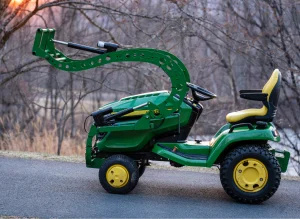
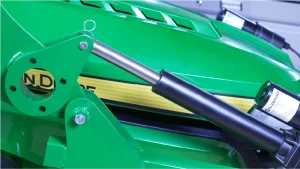
Electric loaders such as the LGM-100 use heavy-duty actuators powered directly by the tractor’s electrical system.
When evaluating a lawn tractor loader attachment, the key question is simple. Do you want mechanical complexity or immediate productivity? For most homeowners, electric delivers results with far less friction.
Lift capacity often attracts attention first, yet balance defines safe and effective loader operation.
Installing a loader capable of lifting more than the tractor’s own weight introduces instability. A properly engineered system matches lift strength with ballast and chassis design.
For most John Deere X300 and X500 owners, a lift range of 300 to 400 pounds delivers the best real-world results. This capacity supports:
Higher lift ratings may create traction loss and stress front components. A well-matched loader feels planted, controlled, and predictable during operation.
Unless fabrication is your hobby, compatibility should be non-negotiable.
Universal loaders often require drilling, cutting, and extensive trial fitting. Model-specific loaders install faster and perform better.
When reviewing a lawn tractor loader attachment, evaluate:
At LGM USA, loader designs focus specifically on the John Deere X300 and X500 platforms. This approach delivers a clean installation that integrates with the tractor rather than forcing adaptation.
Control layout defines how natural the loader feels in use.
Many electric loaders ship with toggle switches. These controls function reliably and keep systems simple.
For homeowners seeking enhanced precision, joystick control systems offer a refined experience.
A joystick enables coordinated lifting and bucket movement, which proves valuable when smoothing gravel or placing mulch around plantings. The tractor responds smoothly, and operation is more intuitive rather than mechanical.
Value extends beyond the purchase price.
A sub-compact tractor with a loader typically costs between $15,000 and $25,000. Ownership also brings additional maintenance, storage, and upkeep.
A quality aftermarket loader for an existing tractor costs significantly less while expanding functionality immediately.
Many owners describe the return in personal terms. Reduced strain. Faster completion. More enjoyment from property projects.
A front-end loader transforms a garden tractor into a versatile utility machine. Tasks that once consumed entire afternoons finish quickly and comfortably. When comparing options, consider both financial cost and physical return.
Choosing the right front-end loader begins with honest expectations.
This category checks every box for the best front end loader for garden tractor owners. It delivers practical lifting power, balanced weight, and straightforward installation.
Ultimately, loader selection is not about charts or pressure ratings. It is about reclaiming weekends and enjoying property ownership.
Modern electric loader technology allows homeowners to work smarter, not harder. By pairing an existing garden tractor with an electric loader, you gain capability without industrial complexity.
Take another look at the tractor in your garage. With the right attachment, it is ready for more responsibility. Let it handle the lifting while you focus on the result.
Hand off the wheelbarrow. You will not look back.
Select a loader based on the heaviest materials you regularly handle. Light tasks like mulch or leaves require less capacity, while gravel, stones, or wet soil demand a higher-rated lifting system to ensure safe and efficient operation.
Compatibility ensures safe installation and operation. The loader must match your tractor’s mounting system and not interfere with key components like the steering, axle, or mower deck to prevent damage or performance issues.
Electric loaders are simpler, cleaner, and easier to maintain since they eliminate hydraulic hoses and oil leaks. They offer a plug-and-play setup that is well-suited for residential landscaping tasks.
The loader’s weight affects front-axle load and steering balance. Choosing a lightweight yet strong attachment helps maintain maneuverability while preventing strain on the tractor’s engine and structure.
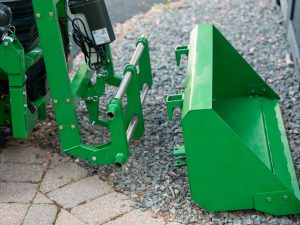
Quick-detach systems allow users to switch attachments easily, making the tractor more versatile. Simple mounting and connections reduce downtime and improve overall usability for homeowners.


© 2026 All Rights Reserved | LGM USA LLC
Added to cart
Check out our shop to see what's available