It’s 9 AM Saturday. Your coffee is still hot. The grass needs cutting. There’s a pile of mulch sitting in the driveway. You walked through Tractor Supply last weekend and stood in front of a row of zero turn mowers wondering if you should pull the trigger.
Here’s the thing most people don’t tell you. For the average homeowner with a half-acre to a couple acres, a zero turn might be the wrong tool entirely.
Not because zero turns are bad. They’re fast, and they cut well. But the way they’re built, the price tags they carry, and the way they actually fit into your weekend, they’re often a worse fit than the lawn tractor sitting next to them on the showroom floor.
Let’s talk through what actually matters for someone like you.
What Zero Turns Are Actually Built For
A zero turn makes the most sense when mowing speed is the whole job. Cut a property fast, get to the next one, repeat. For most homeowners, it solves one task well, but leaves everything else to hand tools, a wheelbarrow, or another machine.
You aren’t trying to cover forty properties a week. You mow your own yard. You cut it once a week. You have one machine, and it lives in your garage. The thing you actually want is to not dread Saturday morning and have the rest of the day for whatever you actually want to do.
A zero turn solves part of that. It cuts grass fast. But it solves it in a really expensive way for problems most homeowners don’t have.
The Hidden Cost of Owning a Zero Turn
The sticker price isn’t the whole story. Zero turns priced for homeowners, the kind you find at the box stores, usually skip the parts that make commercial zero turns last. You get the layout, but with light spindles, smaller pumps, and a frame that flexes more than you’d expect.
Heavier-duty zero turns can get expensive fast. That’s a lot of machine for forty minutes of mowing a week.
And here’s the bigger problem. A zero turn does one thing. It mows. That’s it.
When you need to move that pile of mulch in the driveway, you’re back to a wheelbarrow. Snow needs pushing? You’re shoveling, or you bought a separate snowblower. Got firewood to haul from the back of the property? Wheelbarrow again.
You spent serious money on a machine that mows your grass really fast and does nothing else.
The Lawn Tractor Case
Now look at a John Deere X300 or X500 sitting next to that zero turn. Slower. Less aggressive looking. Maybe not as cool on the showroom floor.
But here’s the thing. That lawn tractor is a chassis. It’s a base. With the right attachments, it does almost everything you actually need a yard machine to do.
Mow grass? Yes. Pull a small trailer or yard cart? Yes. Push snow with a blade or thrower? Yes. Aerate, dethatch, or pull a sprayer? Yes.
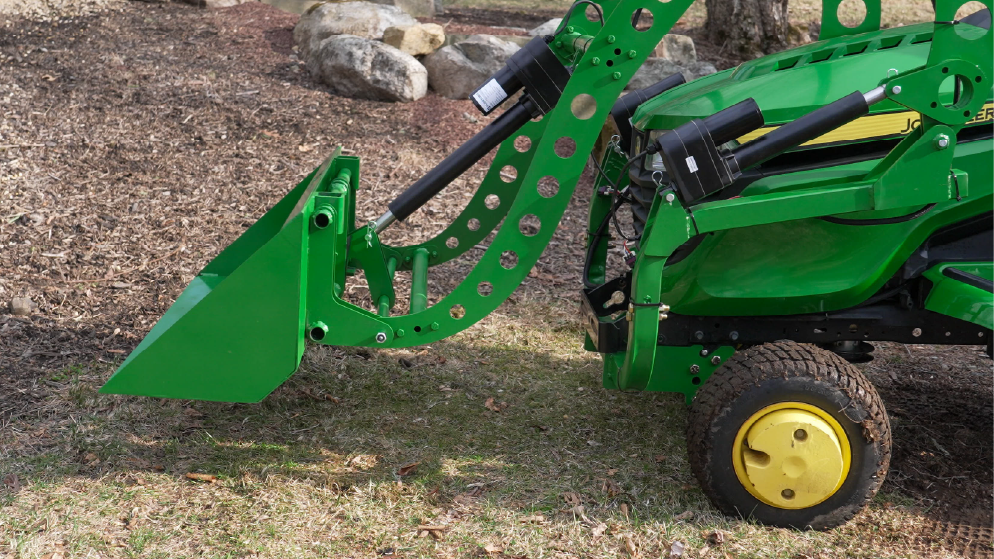
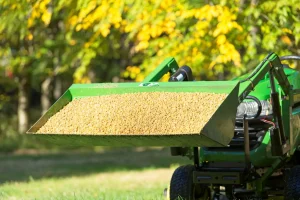
And here’s where it gets interesting. With a front-end loader bolted on the front, that same lawn tractor will move mulch, dirt, gravel, firewood, brush, anything you can scoop. The same machine you bought to cut grass becomes useful for the rest of the yard too.
That’s a different value math than a zero turn. You aren’t buying a single-purpose mower. You’re buying a tool that grows with whatever your yard throws at you.
Front-End Loader on a Lawn Tractor
Most people don’t realize you can put a front-end loader on a residential lawn tractor. Most picture a full-size tractor with a hydraulic loader, the kind that costs more than most people want to spend.
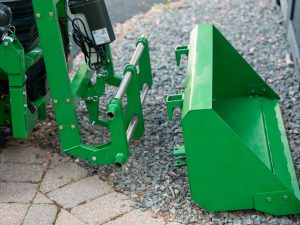
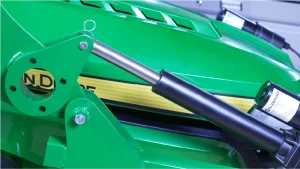
But there’s a quieter category of attachment built specifically for the X300 and X500: electric front-end loaders. They bolt onto the lawn tractor you already own. They lift around 350 pounds. They run off a small linear actuator and a joystick.
The LGM-100 is one of these. It’s what we make. And it’s the reason a lot of homeowners pass on the zero turn entirely.
When you can pick up a few hundred pounds of mulch with the same machine you mow grass on, the conversation changes. Suddenly the lawn tractor isn’t the slower option. It’s the more useful one.
When a Zero Turn Actually Is the Right Call
To be fair, there are homeowners who should buy a zero turn:
- You have three or four acres of mostly open lawn and you cut it weekly.
- Your time is short and you want the cut done as fast as possible.
- You don’t have any other yard tasks that need a powered tool. No mulch beds, no firewood, no driveway that needs grading, no snow worth pushing.
- You have somewhere clean and dry to store a third machine.
If that’s you, a homeowner-grade zero turn might be a fine fit. Just don’t talk yourself into a heavy-duty commercial unit. You aren’t using it the way it was designed to be used.
The Quick Decision Framework
Here’s a gut check before you spend the money.
Ask yourself: outside of mowing, what else am I trying to do in my yard this year?
If the answer is nothing, a zero turn is fine.
If the answer includes any of these, move mulch, push snow, haul firewood, regrade the driveway, pull soil, build a patio, clean out the wood line, lift heavy stuff, then you don’t want a zero turn. You want a lawn tractor with a loader on it. That’s the machine that does all of those things with one chassis, one engine, one battery to maintain.
A zero turn is mainly a mowing machine. A lawn tractor with the right setup does a lot more.
Most homeowners are better off with the one that does more.
The Bottom Line
The shiny zero turn is the easy thing to fall in love with on the showroom floor. Loud. Fast. Looks like power.
But the lawn tractor is the thing that’s still useful when the grass stops growing in October. It’s the thing that pulls the snow blade in January. It’s the thing that hauls a load of dirt for the new garden bed in April.
And with a front-end loader on the front, it’s the thing that finally lets you retire the wheelbarrow for good.
If you already own a John Deere X300 or X500 and want it to do more than mow, take a look at the LGM-100. We built it specifically for the X300 and X500 because we thought there was a smarter answer than buying a separate machine for every job.
Your tractor can do more than cut grass. Make it actually useful.