

If you live in New Jersey, you know the soundtrack of a typical weekend: lawn mowers, leaf blowers, kids playing, someone grilling, maybe a dog insisting the mailman is a threat to national security.
Now imagine, adding a front end loader to that mix without sounding like a construction site.
That’s where the electric front end loader garden tractor really shines. Instead of a noisy hydraulic system, you get quiet, precise power that won’t make your neighbors glare over the fence. Additionally, the combination of its small size and low noise level is a game changer for suburban yards in New Jersey, where residences are near to one another and drives are short.
In this post, we’ll break down what an electric tractor loader actually is, why it makes sense for New Jersey suburbs, and how LGM USA’s LGM-100 loader – built specifically for John Deere X300 and X500 lawn and garden tractors, fits into the picture.
Let’s start simple.
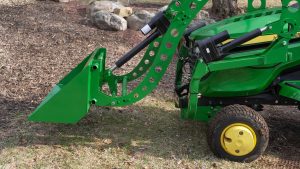
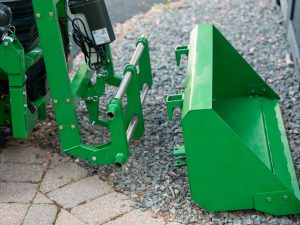
A lawn tractor front end loader is a bucket and arm system that mounts to the front of your lawn or garden tractor. It lets you scoop, lift, carry, and dump materials like mulch, stone, soil, and firewood without a wheelbarrow workout.
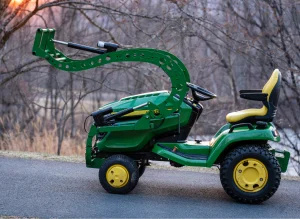
Most loaders you’ve seen on farms or construction sites use hydraulics. LGM USA went a different route with the LGM-100, a powerful electric front end loader designed specifically for John Deere X300 and X500 series tractors.
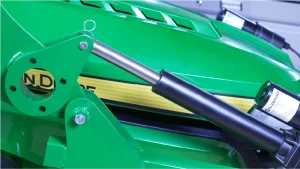
Instead of hydraulic pumps and hoses, the LGM-100 uses heavy-duty electric linear actuators (ball screw style) that provide the lifting and tilting power for the bucket.
In plain English:
And because LGM USA builds these specifically to fit all John Deere X300 and X500 garden mowers and lawn tractors, you’re not trying to force a generic attachment to work on your machine.
New Jersey neighborhoods are… let’s say “cozy.” Driveways aren’t huge. Property lines are close. You might share a fence line with three different families.
In addition to the sound of the tractor itself, a standard hydraulic loader configuration adds additional engine revs, pump whine, and mechanical noise. On a large rural property, that is acceptable. In a Morris County cul-de-sac at 8 a.m. on Saturday? Not so much.
An electric front end loader garden tractor setup brings some real quality of life perks:
An electric system is a huge boost, not just for you but for everyone who lives near you, if you’ve ever put off a big yard project because “the noise is going to be too much.”
Let’s talk about real-world jobs on a residential or commercial property.
With an electric tractor loader like the LGM-100 on your Deere, you can tackle:
The LGM-100 is marketed specifically as a versatile electric front-end loader for homeowners and weekend warriors, not commercial crews.
That’s important: it’s built to solve your weekend problems, not to dig basements or work for 10-hour shifts on job sites.
On paper, hydraulics and electric systems both move a bucket up and down. But in day-to-day use around your New Jersey yard, the experience is pretty different.
From a “consumer” point of view, that means:
Hydraulics aren’t horrible, they’re just not suited to a lot of homes. The electric version works better for how most people actually use their devices.
A big part of the appeal of a lawn tractor front end loader is that it fits the spaces you really live with:
A compact John Deere tractor plus an electric front end loader garden tractor setup is a lot easier to maneuver in those environments than a full-size compact tractor or skid steer. You already know how your mower feels on hills and around trees, adding a loader lets you use that same familiarity to handle heavier work.
Our nimble, flexible electric loader can “turn yard work into yard play” and “turn any outdoor space into a showcase.”
It can help you finish enormous projects in little spaces without ruining your landscape or your nerves.
LGM USA is based in Long Valley, New Jersey, and we focus specifically on electrically powered front end loaders for lawn and garden tractors.
That local connection matters more than you might think:
When a corporation is in the same environment as you, its products tend to show that. The LGM-100 isn’t meant to be everything to everyone. It’s an electric tractor loader made just for folks who have John Deere X300/X500 tractors and live in the suburbs or semi-rural areas.
If you’re on the fence, try walking through these questions:
If you’re nodding “yes” to most of those, then an electric front end loader garden tractor setup is probably going to feel like a very natural upgrade.
At the end of the day, the appeal of an electric loader is simple:
You get to keep using the tractor you already like — your John Deere X300 or X500 — and turn it into a quieter, more capable work partner for your property.
Instead of:
The LGM-100 from LGM USA is a perfect illustration of what this can look like in real life. It’s a purpose-built, electric front-end loader for John Deere X300/X500 tractors.
Quiet power. Real lifting capacity. No hydraulic headaches. And a whole lot fewer wheelbarrow miles.
An electric front-end loader garden tractor arrangement might be just what your yard has been waiting for if you’re ready to go from “I should really tackle that project someday” to “I got that done this weekend.”
An electric loader offers the right balance of compact size and lifting power for suburban yards where full-size equipment is impractical. It helps homeowners handle mulch, soil, and landscaping materials efficiently without the cost or complexity of larger industrial machines.
Electric loaders operate quietly compared to hydraulic systems, making them suitable for neighborhoods with close homes or noise restrictions. This allows yard work to be done early or late without disturbing neighbors.
It simplifies seasonal cleanup by efficiently moving wet leaves, branches, and storm debris. This reduces manual labor and speeds up property maintenance during heavy seasonal transitions.
Since electric loaders do not use hydraulic fluids, they eliminate the risk of oil leaks that can stain driveways or damage lawns, helping preserve the visual appeal of well-maintained suburban properties.
Yes. The plug-and-play design allows most homeowners to install the system using basic tools in their garage, avoiding the need for professional installation or complex mechanical work.


© 2026 All Rights Reserved | LGM USA LLC
Added to cart
Check out our shop to see what's available