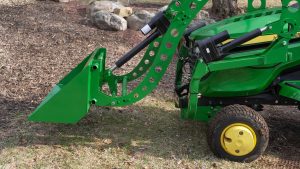


If you have added a loader to your John Deere, or you are about to, you have probably already discovered one of the first truths of tractor ownership: traction is everything. The loader increases what your machine can accomplish, and the correct traction setup is what turns that capability into something usable and predictable. This clear and practical guide from LGMUSA will help you decide whether you need tire chains, rear weights, or a combination of both on your John Deere X300 or X500, and how to choose a setup that performs well without tearing up your lawn or creating stress while you work.
You will find real-world scenarios, simple checklists, and straightforward weekend-ready tips. This applies directly to anyone running a garden tractor loader, a John Deere X300 front loader, or a John Deere X500 front loader attachment, since the same traction principles apply to all of these configurations.
That is the quick overview. Now let’s turn those ideas into everyday choices that help you work with confidence.
Once a loader is added to the tractor, three things change immediately:
A loaded bucket shifts mass toward the front of the tractor which lightens the rear axle, and the rear axle is where your drive tires live. When the rear tires carry less weight, they simply grip less.
A raised bucket increases the center of gravity and moves it forward. This makes smooth control and stability much more important, especially when moving heavier loads.
With more capability, you naturally take on tougher tasks. You scoop heavier material, climb steeper approaches, and deal with winter piles. All of this is good as long as the rear tires have the support they need.
Rear weights return stability and authority to the rear axle. Tire chains create the mechanical grip that regular rubber cannot achieve on slick or frozen surfaces. Once they work together, your X300 or X500 feels planted, predictable, and far more enjoyable to use.
They increase the downward force on the rear tires so the rubber can do its job. They do not harm working surfaces, they are always active, and they quietly improve steering, stopping, and stability when the loader is in use.
They physically bite into ice, packed snow, slick clay, wet pine needles, algae-coated concrete, and dusty hardpack. They will not help much in deep mud, which turns everything into traction soup, but on most slippery surfaces they are incredibly effective.
It is not a choice between one or the other. Weights restore traction potential. Chains unlock that potential when the ground resists.
Use this simple, feel-based rule:
If you can start moving smoothly, steer confidently, and stop calmly with a typical bucket load, and the turf is not showing clean crescent dents when it is dry, you are likely in the correct range.
If the rear feels light when you brake or you spin even on mild slopes, add a little more weight.
If turning becomes sluggish or you begin marking your lawn in dry weather, you have gone too far and should remove a plate.
Practical choices for the X300 and X500 include:
Start with a smaller amount than you expect, test with a normal bucket load, and adjust in increments of twenty to twenty-five pounds until the tractor feels planted.
Chains come in several patterns that balance traction with lawn friendliness:
Cross chains appear on every other side link. This gives strong, frequent contact and excellent bite, which works especially well on icy hills.
Smoother riding and gentler on turf but still helpful on slick surfaces.
Outstanding traction on glare ice and frozen hardpack. They are tough on lawns and should be considered for true winter duties.
Excellent lateral grip and steady steering feel. These are generally more expensive but are very well behaved on mixed surfaces.
Correct fit matters. Confirm your rear tire size, such as 22×9.5-12, and make sure there is proper clearance around the fender and linkages when the tire flexes under load. Chain tensioners or bungee cords help the chain ride snugly and quietly.
Within the safe range printed on your sidewall, running the pressure toward the lower end increases the contact patch and helps prevent wheelspin, especially on turf. Recheck tire pressure during major temperature swings since cold winter air reduces PSI.
Surface: dry turf and a paved driveway
Loads: light and fluffy materials
Best setup: rear weights only. Keep the bucket low, drive smoothly, and avoid tight turns while carrying a load. If rain softens the ground, reduce scoop size or wait for drier conditions.
Surface: packed snow, ice, gravel, and freeze-thaw ruts
Loads: wet snow, dense piles, and occasional stone
Best setup: chains combined with rear weights. This is the classic winter configuration for an X300 or X500 with a front loader attachment. Use steady throttle, keep the bucket low, and do not crest hills faster than you can stop on ice.
Surface: lawns you care about alongside rougher work zones
Loads: moderate to heavy
Best setup: begin with weights. If the rear hops on a slope or braking feels extended, add four-link chains for the days when you need extra traction, then remove them when performing finish work on dry turf.
Surface: manicured turf and irrigated areas
Loads: compost, brush, and light soils
Best setup: begin with weights, schedule work for dry days, and use plywood paths or wide boards for tight turns near delicate areas. Only use chains when absolutely necessary and choose turf-friendly patterns.
Spring: soft turf and wet edges mean weights are useful and chains should be avoided unless absolutely necessary.
Summer: dry turf and gravel favor weights alone, with chains reserved for rare slick areas.
Fall: leaf mold and wet clay respond well to weights, and chains can be added on slope days.
Winter: snow, ice, and hardpack almost always call for chains and weights together until the freeze-thaw cycle ends. Remove chains when the ground softens.
This quick routine provides more clarity than any spec sheet:
If anything feels light or unstable, add a plate. If steering feels sluggish or the lawn dents in dry weather, remove one. If you are still spinning or sliding, install chains.
They do not damage frozen ground, gravel, or hardpack. They can harm soft spring turf. Use them only when you need them, and remove them afterward. If you must use chains on your lawn, choose a gentler four-link or diamond pattern and work only when the ground is dry.
Not always. Start with weights. If braking still feels long or starting is slippery, especially on slopes or during winter, add chains. Many owners use both in winter and run weights alone for the rest of the year.
Front weights are not ideal for loader work because you want mass behind the rear axle to counterbalance the loader. Front weights work against the balance you need.
Turf tires combined with chains and weights handle far more than most owners expect. Aggressive tread helps in softer ground but can damage lawns. Choose based on how important turf appearance is to you.
If you dent a dry lawn, if steering becomes sluggish, or if the tractor feels heavy and slow on flat ground, remove a plate and retest.
Spinning on a mild slope with an empty bucket
Pressure may be high or the ground may be damp. Lower PSI within the safe range and wait for drier conditions.
Sliding during downhill stops
You do not have enough rear bite on a slick surface. Add chains and keep the bucket low.
Rear wheel hop under load
Either the bucket load is too heavy or you do not have enough ballast. Take a smaller scoop or add more weight.
Visible lawn marks in dry conditions
You are over-ballasted or turning too sharply under load. Remove a plate and make wider turns.
On flat, dry ground with lighter materials, rear weights are often all you need. When you introduce slopes, snow, icy surfaces, slick gravel, or heavier bucket loads, chains become essential. During winter or when working on steep grades, the combination of chains and weights gives you the most stable, predictable, and confidence-building setup.
The ultimate goal is simple: match your traction setup to the real-world work you expect from your John Deere X300 or X500 so you can start, steer, and stop with confidence while still protecting your lawn.

© 2026 All Rights Reserved | LGM USA LLC
Added to cart
Check out our shop to see what's available