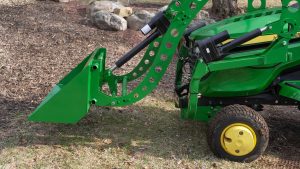

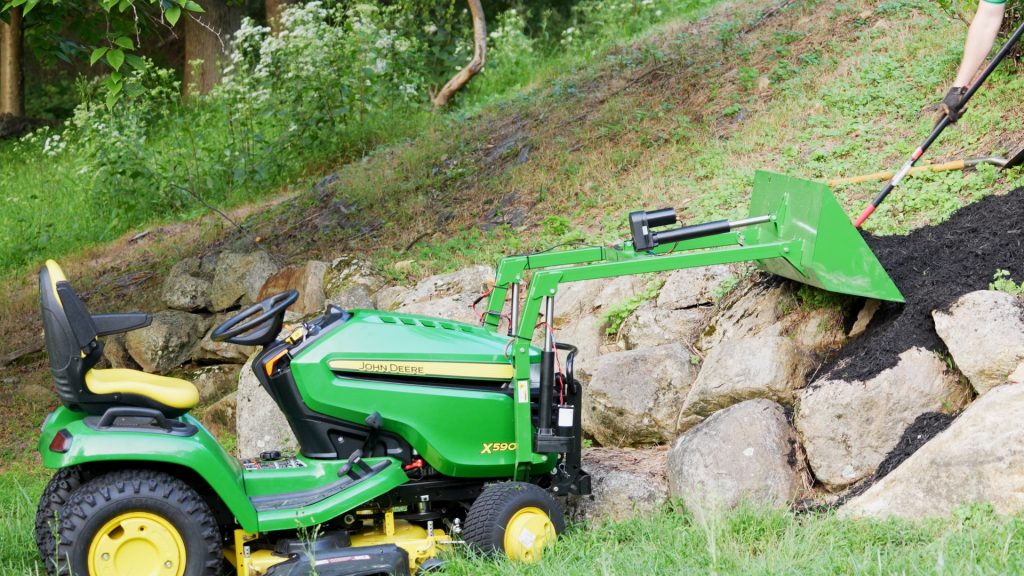
It’s 8 AM Saturday. Coffee in hand. You walked out to the garage, fired up the X300, climbed on, pushed the joystick on the LGM-100, and nothing happens. Or it tries to lift, then stops halfway. Or it groans and clicks but the bucket sits there.
Mulch is sitting in the driveway. The kids’ soccer game is at 11. You’ve got about an hour to figure out what’s wrong before you have to either get this thing working or give up and use a wheelbarrow.
Good news. Most of what goes wrong with an LGM-100 is something you can sort out in your own driveway with basic tools. You don’t need a hydraulic pressure gauge. You don’t need to pull the actuator apart. You need to know what to check and in what order.
Here’s a homeowner troubleshooting guide for the LGM-100. Built by symptom. If your loader is doing the thing in the heading, jump to that section, work through the checks, and see if you can have it back to working before the soccer game starts.
The LGM-100 is electric. There’s no high-pressure hydraulic line that’s going to spray you with hot fluid. That’s one of the reasons we built it electric instead of hydraulic. But you still need to be smart.
Now to the symptoms.
You push the joystick up and nothing happens. No click. No motion. No noise from the actuator.
This is almost always electrical. The LGM-100 runs off the tractor’s 12V battery through the actuator. If power isn’t getting to the actuator, nothing moves.
If the battery is strong, the connections are clean, and there’s no visible damage to the wiring, but the loader still won’t move when you push the joystick, the actuator itself may have failed internally. That’s the time to get on the phone with us.
You push the joystick. You hear a click. Maybe a soft hum. But the bucket doesn’t actually move.
This one usually means the actuator is getting a signal but can’t deliver the motion. Two main causes.
If you’ve ruled out the battery, the load, the temperature, and the grease, and the actuator is still just clicking, it’s likely an internal issue with the actuator motor or the gearset. Time to call.
You park the tractor with the bucket halfway up. You come back in the morning and it’s drooped two or three inches. Or worse, it’s all the way to the ground.
First thing. This is not actually a problem you need to fix in most cases. It’s just a thing electric actuators do over long periods. They’re not built to hold a load up indefinitely with the engine off.
That said, if the sag is dramatic, fast, or getting worse, that’s a different story.
If the bucket sags fast (a couple inches in five minutes) or all the way down with no load on it, the actuator may need service. Stop using the loader and contact us. That’s a service call.
You’re pushing the joystick and the loader is doing something different than you’re asking. Or the loader twitches when you’re not touching the joystick. Or the joystick feels mushy or notchy.
If the joystick is dead and the wiring is good, the joystick itself probably needs to be replaced. We stock them. Quick fix.
The bucket is going up. Just slower than it used to. Or you hear the actuator whining harder than normal.
If you’ve eliminated weight, battery, grease, and temperature, and it’s still slow, that’s worth a conversation. We can usually narrow it down over the phone.
You can feel play in the loader arms. The bucket wobbles side to side when you tilt it. Things just feel less tight than they used to.
This one is almost always mechanical, and almost always something you can fix in the driveway.
If you see a cracked weld or a bent arm, do not keep using the loader. Call us. We’ll figure out the path to repair or replace the affected part.
Here’s the rough rule of thumb.
Try it yourself first: Anything battery-related. Anything connector-related. Anything you can fix with grease, a wrench, or a fresh fuse. Wiring inspection. Cleaning. Tightening hardware.
Call us: Internal actuator failure. Cracked welds or bent metal. Joystick failure if the wiring is fine. Anything where you feel like you’re guessing or you don’t have the right tool.
The thing to remember is the LGM-100 was built to be simple. Electric. One actuator. One joystick. A few mounting points. There aren’t that many things that can go wrong, which is also why most of what does go wrong is something a homeowner can fix in his own driveway. For a fuller explanation of how we approached the design and the issues you might run into, see our piece on common front-end loader problems and how we solve them.
Before you give up on a Saturday morning, run through this list in this order.
A lot of the time, the answer is in the first four: battery, connector, wiring, and grease. Battery, connector, wiring, grease. That’s the entire diagnostic kit for a homeowner with an electric loader.
If you want to stay ahead of these issues so they don’t happen on a Saturday morning when you’ve got mulch to move, work through the regular maintenance items in our guide on front-end loader maintenance tips that extend the life of your attachment. Twenty minutes a month and most of these symptoms never show up.
The LGM-100 isn’t complicated. We built it that way on purpose. Electric instead of hydraulic. One actuator instead of a pump and a tank and a relief valve and four hoses. A joystick instead of a six-lever console.
That simplicity is what makes it the right loader for a homeowner. It’s also what makes it possible for you to fix most of what goes wrong without leaving your garage.
Charge the battery. Clean the connector. Look at the wiring. Hit the grease zerks. Then if it’s still not right, give us a call. We’d rather have a five-minute phone conversation with you than have you guess at it.
If you already own a John Deere X300 or X500 and you want it to do more than mow grass, take a look at the LGM-100. It’s built for homeowners. It’s built to be fixable in your own driveway. And it’s built so that the kind of bad day described at the top of this post is the exception, not the routine.
Your tractor can do more than cut grass. Make it actually useful.
The most common cause of a complete loss of movement is an electrical interruption. Inspect the wiring harness for loose or damaged connections and ensure the battery is fully charged. Also check the fuse or circuit breaker, as it may have tripped to protect the linear actuator from overload.
Slow or weak operation is often caused by a low battery charge or corroded terminals. Clean battery posts, verify alternator performance, and ensure strong electrical contact. Mechanical friction from dry or dirty pivot points can also reduce performance, so proper lubrication is essential.
Jerky movement usually indicates a mechanical issue. Check for bent components, debris in the mechanism, and ensure all pivot points are properly lubricated. Uneven lifting may also result from misaligned or loose clevis pins or mounting bolts.
If the motor runs but there is no movement, the issue may be internal to the actuator, such as a worn drive system or misaligned limit switches. Ensure nothing is physically blocking the loader. If internal failure is suspected, the actuator may need repair or replacement.
Regular maintenance is key. Clean electrical connectors to prevent corrosion, maintain a strong charging system, and inspect fasteners weekly. Consistent lubrication of all moving joints reduces wear and prevents mechanical binding or jerky operation.


© 2026 All Rights Reserved | LGM USA LLC
Added to cart
Check out our shop to see what's available