

There is a very specific feeling that every homeowner and DIY landscaper in the USA knows. It’s that Friday afternoon buzz. You’ve just clocked out of work, the weather forecast for the weekend is a perfect 72 degrees and sunny, and you have a mountain of plans. Maybe it’s that massive pile of topsoil sitting in the driveway that needs to be spread. Maybe it’s finally time to grade the backyard for that patio you’ve promised your spouse for three years. Or maybe winter is coming, and you need to move five cords of firewood before the first snow flies.
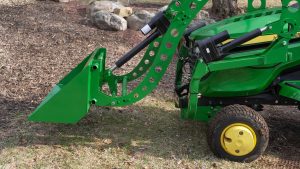
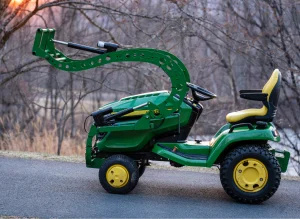
You walk into the garage, coffee in hand, and look at your tractor. It’s not just a lawn mower anymore, since you added the LGM-100, it’s a beast. It’s your back saver. It’s your Little Green Monster. You’re ready to attack the project.
But here is the question that stops many of us in our tracks: Is your loader actually ready?
We have all been there. You get twenty minutes into the job, you’ve got a full bucket of gravel raised mid air, and suddenly something feels off. A sluggish actuator? A loose bolt you forgot to tighten after last season? Suddenly, your power weekend turns into a troubleshooting weekend. The momentum dies, the mulch sits there mocking you, and you’re back on the phone looking for parts instead of moving dirt.
That is exactly why we introduced the Loader Health Check. It’s not just a service, it’s an insurance policy for your weekend. And the best part? You don’t even have to trailer your tractor to a shop. With our Remote Inspection Service, we bring our expert eyes right into your garage, digitally, ensuring your equipment is as ready to work as you are.
At LGM USA, we built our brand on a simple promise: Lift it, Move it, DO it. We believe that with the right tools, a regular homeowner can do the work of a professional crew. But we also know that our customers are busy people. You are dads, moms, professionals, and retirees who value time. You don’t have days to waste waiting for a repair shop to have an opening, and you certainly don’t want to pay hundreds of dollars just to have someone tell you a wire was loose.
We realized that 90 percent of the issues our customers face aren’t catastrophic failures. They are small, preventative things like wear and tear that creeps up over time. A slightly frayed wire here, a dry pivot point there. Things that are easy to miss when you see the machine every day, but glaringly obvious to the eyes of the engineers who designed it.
We wanted to bridge that gap. We wanted to offer a front end loader inspection service that fits your life. We didn’t want you to have to haul your John Deere X300 or X500 halfway across the county. We wanted to do it on your schedule, using the technology you already have in your pocket.
Thus, the Remote Inspection Service was born. It is our way of standing right there next to you in the garage helping you give your machine a once over before the heavy lifting begins.
You might be wondering, “How can you inspect my loader through a phone?” It’s a fair question. But you’d be amazed at what high definition video and a trained ear can pick up.
When you book a Loader Health Check, you aren’t getting a generic checklist. You are connecting with a technician who knows every curve, weld, and bolt of the LGM-100. We treat it like a doctor’s appointment for your machine.
Here is a peek behind the curtain of what we are looking for when we jump on a call with you:
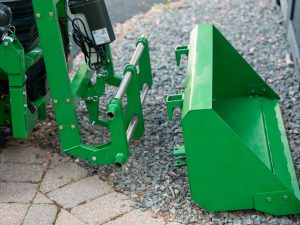
First, we look at the bones. We will guide your camera to the high stress areas. We are looking at the uprights and the mounting brackets. These are the parts that take the brunt of the force when you are digging into a pile of wet clay. We look for those tell tale signs of stress, micro cracks in the paint that might indicate metal fatigue, or bolts that have backed out just a millimeter or two. It sounds obsessive, but catching a loose sub frame bolt now takes five minutes with a wrench. Catching it after it shears off mid lift? That’s a whole different story.
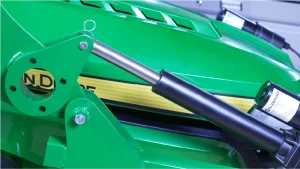
The electric linear actuators are the heart of the LGM-100. They give you that hydraulic-like power without the messy hydraulic leaks. During the inspection, we will ask you to run the loader through a specific series of movements, full lift, full dump, hold, and retract.
We aren’t just watching, we are listening. A healthy actuator has a specific hum. A struggling one has a groan. We can hear if the motor is straining, which might indicate an alignment issue or a need for lubrication on the piston rod. We check the speed consistency. Is the left side moving slightly faster than the right? That could mean your bucket is twisting, which puts uneven load on the frame. We spot these synchronization issues instantly and walk you through the re-calibration process right then and there.
This is the big one. Your loader lives outdoors. It deals with dust, mud, snow, and vibration. Wiring harnesses can rub against the tractor frame, and connections can corrode. Our Remote Inspection Service is rigorous about this. We will have you trace the harness from the battery all the way to the joystick or switch box.
We are looking for chaffing spots where the protective loom has worn through. We check the relay connections to ensure they are tight and free of that green, crusty corrosion that kills voltage. We check the joystick responsiveness. Does the bucket stop exactly when you let go of the stick? If there is drift, or a delay, we diagnose it immediately. Often, it’s just a loose ground wire, but finding it alone can take hours. With us guiding you, it takes minutes.
Let’s talk about why this matters. It’s not just about the machine, it’s about the project.
Imagine you have rented a dumpster for the weekend to clear out debris. That dumpster has to go back on Monday. You are on a clock. If your loader goes down on Saturday morning, you are stuck loading that dumpster by hand. Nobody wants that.
Or consider the safety aspect. We are talking about lifting hundreds of pounds of material. A Loader Health Check is a safety check. We ensure that the locking pins are engaged correctly, that the ballast on your tractor is sufficient for the loads you plan to move, and that the emergency stops are functional. We want you to have fun using your tractor, but we also want you to be safe.
We had a customer recently, Mike from Ohio. Mike was planning to move about 20 yards of mulch for his daughter’s wedding, which was being hosted in their backyard. He booked a remote inspection just to be safe. During the video call, our tech noticed that the main pivot bolt on the left lift arm was missing its cotter pin. The nut was holding, but vibration would have eventually worked it loose.
If Mike had started that job, the arm could have detached with a full load of mulch. It would have damaged the tractor, potentially hurt someone, and definitely ruined the wedding prep. Instead, we spotted it, Mike popped in a ten-cent cotter pin, and he finished the job two days early. That is the value of a second set of eyes.
We know that remote inspection can sound tech heavy, but we have designed this to be incredibly simple. You don’t need special apps or a degree in computer science.
It is personal, it is interactive, and honestly, it’s often a lot of fun. We love seeing what you guys are building and working on. It’s the best part of our job.
When you buy from LGM USA, you are buying into a community. This front end loader inspection service is our way of honoring that relationship. We know that American manufacturing and American DIY spirit are about pride. You take pride in your home, and we take pride in the equipment we build to help you maintain it.
This service is also a great opportunity for education. A lot of our customers are new to owning a front end loader. During the inspection, we often find ourselves giving out “pro tips.” We might show you a better way to grease a fitting, or explain how to approach a pile of dirt to minimize strain on the tractor. It’s a coaching session disguised as an inspection.
We want you to feel like an expert operator. We want you to know the difference between a normal operating sound and a “stop immediately” sound. The Remote Inspection Service empowers you. It takes the mystery out of the machinery.
We recommend a checkup at a few key times:
Your projects are big. Your time is valuable. And your back certainly doesn’t need to be doing the work that your tractor was built to do.
The Little Green Monster is designed to be tough, reliable, and hardworking, just like you. But even the toughest machines need a little TLC now and then. Our Loader Health Check is the easiest, most efficient way to ensure that when you turn that key and push that joystick, the only thing that happens is exactly what you want to happen.
Don’t wait for the breakdown. Don’t wait for the frustrating Saturday afternoon surprise. Be proactive. Let us jump on a call with you and give your machine the green light.
Check out our support page today to find out more about scheduling your Remote Inspection Service. Let’s get you ready to Lift it, Move it, and DO it, without a hitch.
See you in the garage!
This service allows homeowners to receive professional diagnostic support remotely using photos or videos of their loader. Technicians analyze the equipment to detect wear, installation errors, or electrical issues without requiring transport to a service center.
Remote inspections focus on early detection of issues like loose fasteners, misaligned brackets, or damaged wiring. Identifying these problems early helps prevent serious mechanical failures and extends equipment life.
Technicians examine the linear actuator, pivot points, frame mounts, and electrical connections. This ensures that both mechanical and electrical systems are functioning safely and efficiently.
Yes, new owners can verify proper installation by sharing images of their setup. Technicians confirm correct pin placement, secure mounting, and safe wiring to ensure safe operation from the start.
It eliminates the need for transporting heavy equipment to a service center. Many issues can be resolved through simple guidance, reducing repair costs and avoiding unnecessary service visits.

© 2026 All Rights Reserved | LGM USA LLC
Added to cart
Check out our shop to see what's available