

It’s a Saturday in April. You’re standing in the driveway with a cup of coffee, looking at a pile of mulch the supplier dropped yesterday. The flower bed your wife wants refreshed is a hundred feet away on the other side of the house. There’s also a half-empty bag of grass seed on the porch and a shovel leaning against the garage that you haven’t moved in three weeks.
Last weekend you got a quote from a guy to do all of it. Mulch the beds, regrade a soft spot in the driveway, haul a couple cords of firewood up from the back of the property. He came back with a quote that ran into the thousands and could not start for weeks.
You stand there a minute and do the math in your head. Eighteen hundred bucks. Three weeks of waiting. Some random guy and his truck in your driveway on a day you wanted to be home. You’ve got a John Deere X300 sitting in the garage that you bought to mow with. You start wondering whether there’s a smarter way to handle this.
That’s the question this post is here to walk through. When does it make sense to call a guy, and when does it make sense to put a loader on the front of your tractor and just do it yourself?
For most homeowners, calling somebody is the path of least resistance. You don’t have to think about it. You don’t have to find a tool. You don’t have to spend a Saturday in the sun. You write a check and the work shows up done.
That’s the appeal. And honestly, for some jobs, it’s the right call. We’ll get to those.
But there’s a hidden cost to outsourcing yard work that doesn’t show up on the invoice. You’re on his schedule, not yours. The mulch goes down when he can fit you in, not when the weather’s right and the beds are ready. He shows up with two helpers and tracks dirt across your lawn. You stand there feeling slightly out of place watching strangers work on your own property. And next time the same job needs doing, in six months or a year, you’re back at square one writing another check.
For a homeowner who actually likes being outside on his own property, that adds up.
Let’s take that mulch-and-firewood Saturday and actually price it both ways.
Hiring it out costs real money, and the exact number depends on your area, the volume of mulch, and how much hauling is involved. That’s labor for two or three guys, fuel for their truck, the markup that covers his insurance and his time getting the quote, and the convenience premium of you not having to lift a finger. The price tag is the price tag. You write the check.
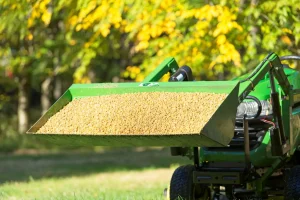
Doing it yourself with the right loader on your tractor, the math is different. The mulch and the firewood you’d be paying for either way. What you’re really comparing is the labor cost. If you’ve got a front-end loader on your X300, that Saturday goes from a back-breaking wheelbarrow marathon to a few easy laps with the tractor. Three or four hours of relaxed work. You’re not paying yourself, so the labor side of the equation drops to zero.
The first time you do that math on a single weekend project, the contractor quote starts looking different. The second time you do it, on the next mulch run or the firewood haul or the gravel you need spread, the math gets even better. If you use it regularly for mulch, gravel, firewood, and snow, the loader can start making financial sense a lot sooner than most homeowners expect.
This is where a lot of homeowners get hung up. They look at the price of a loader attachment and they think it’s expensive. Compared to what?
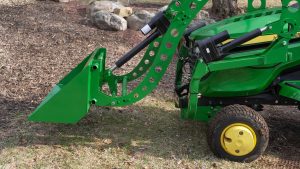
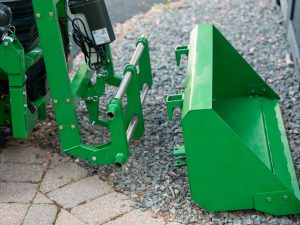
A residential electric front-end loader for an X300 or X500 is a fraction of what most people assume. It’s not a skid steer. It’s not a heavy-duty piece of equipment that costs more than most homeowners want to spend. It bolts onto the tractor sitting in your garage right now. It is designed to bolt onto compatible John Deere X300 and X500 tractors.
A reasonable install effort of contractor labor saved gets you a meaningful chunk of the way to paying for a loader outright. A handful of weekends and you’re net positive. After that, every project you do yourself is pure savings against what you would have paid the next guy.
And here’s the part that doesn’t show up in a spreadsheet. You own the tool. It’s there next weekend, and the weekend after, and three years from now when the next mulch delivery shows up. You don’t have to find somebody, get a quote, schedule it, wait three weeks, and write another check. You walk out to the garage, climb on the tractor, and get it done before lunch.
If you want a deeper look at how an electric loader compares to other options, the post on electric vs hydraulic loaders for homeowners walks through that side by side.
Some weekend projects are practically begging for a loader on your tractor. You’ll know one when you see it.
Mulch in the flower beds. Two yards of mulch is forty wheelbarrow loads. With a loader, that’s six or seven scoops and you’re done by lunch. This one alone is the reason a lot of homeowners get a loader in the first place.
Firewood from the back of the property to the porch. If you heat with wood or just like a fire on the deck, hauling cords by hand burns half a Saturday and your back. A loader lets you move manageable loads of firewood a lot faster than hauling it by hand or by wheelbarrow.
Gravel for the driveway. A few yards of gravel for the soft spots, the edges, the place by the mailbox where everything keeps washing out. Spread it with the loader instead of a shovel and you’ll wonder why you ever did it the hard way.
Topsoil for a new garden bed or grass repair. Same story. A pile in the driveway turns into a finished garden bed in an afternoon instead of a wrecked back over three days.
Snow off the driveway in January. Push it instead of shoveling it. The loader bucket doubles as a perfectly good snow pusher for a residential driveway. No more hiring a plow guy who shows up at 6 AM after you’ve already shoveled.
Brush from the wood line out to the burn pile. Drag it, scoop it, dump it. One trip with the loader replaces an hour of hauling brush by hand.
None of these are jobs that need a guy with a truck. They’re jobs that need a tool and a Saturday morning. The post on whether an electric front-end loader is powerful enough for home projects covers more of these use cases in detail if you want to see the range.
To be honest, there are jobs that belong to a hired pro. The loader doesn’t fix everything, and pretending it does is how you end up with a half-finished mess in your yard.
For everything else, the loader almost always wins on cost, on schedule, and on the satisfaction of getting it done yourself.
Money is the easy part of this comparison. There’s other stuff worth thinking about.
Your schedule, not his. The mulch goes down on the Saturday morning you wanted, not the Tuesday afternoon when he could fit you in. The driveway gets graded the weekend before you have company over, not three weeks after. You stop waiting on other people’s calendars to make your own property look right.
The work gets done your way. You know how thick the mulch should be in your beds. You know where the firewood goes on the porch. You know which corner of the driveway needs the gravel. When you do it yourself, it’s done your way without a back-and-forth or a misunderstanding.
You learn the tool. The first weekend you use a loader feels a little awkward. By the third project, you’re moving fast and confident. That’s a skill you keep. That’s a tool you own. That’s something nobody can charge you for again.
You actually enjoy your property. There’s a reason you bought the X300 in the first place. You like being outside. You like the sound of an engine and the feel of getting work done. A loader on the front of that tractor is the difference between dreading a project and looking forward to a Saturday morning.
If you’re not sure whether your tractor is ready for a loader at all, the post on signs you’re ready to upgrade your tractor with a front-end loader is a good gut check.
Here’s how to make this call in about thirty seconds the next time a yard project lands on your plate.
Step one. Get the quote. Call somebody and find out what they’d charge. Get a real number. Even if you’re going to do it yourself, having the comparison in front of you makes the math obvious.
Step two. Ask whether the work is in the loader’s wheelhouse. Mulch, dirt, gravel, firewood, snow, brush, light grading. If the answer is yes, you’re a candidate to do it yourself. If the answer involves trees, trenches, foundations, or permits, you’re calling a guy.
Step three. Be honest about your weekend. Do you actually want to be outside Saturday morning? Or would you genuinely rather pay for it and be done? There’s no wrong answer here, but there is a true answer. Don’t talk yourself into a project you’re going to resent.
Step four. Add up the next twelve months. If this is a one-and-done project, paying for it once might be the right call. If it’s the kind of work that’s going to come back twice a year for the next decade, the loader is going to pay for itself fast and then keep paying.
Step five. Decide. You don’t have to do every project the same way. Some weekends you’ll want the satisfaction of doing it yourself. Other weekends life is full and writing a check is the right move. The point is to make the call deliberately instead of defaulting to the contractor every time.
For most homeowners with a John Deere X300 or X500 and a list of yard projects piling up, putting a front-end loader on the tractor changes the math.
You stop waiting on somebody else’s schedule. You stop writing checks for work you could enjoy doing yourself. You stop dreading the mulch delivery and the firewood haul. You start finishing projects on the Saturday you wanted to do them, with a tool you already own.
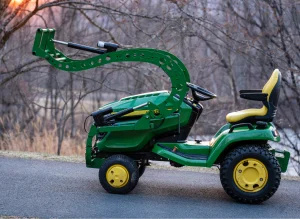
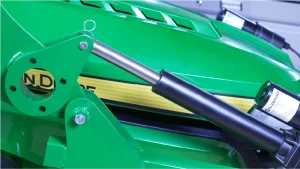
The LGM-100 is built specifically for the X300 and X500. The LGM-100 is designed to bolt onto compatible John Deere X300 and X500 tractors. It lifts around 320 pounds, which makes it a practical fit for typical homeowner jobs like mulch, gravel, firewood, dirt, and snow when used within its rated capacity. It runs off an electric actuator and a joystick instead of a hydraulic system, which keeps it simple to install, simple to use, and simple to maintain.
Your tractor can do more than cut grass. Make it actually useful.
Hiring contractors involves recurring hourly labor charges and service fees, while owning a loader is a one-time investment. Over time, it reduces ongoing costs for tasks like moving mulch, gravel, and soil around your property.
Owning a loader gives you full control over your schedule, allowing you to complete projects whenever conditions are ideal. This avoids delays caused by contractor availability, especially during peak seasons.
A loader provides the mechanical strength needed to move heavy materials for tasks like retaining walls or brush clearing, enabling homeowners to complete professional-level landscaping without external help.
It allows for immediate response to seasonal or weather-related issues such as fallen branches or driveway damage, helping prevent small problems from becoming costly repairs and keeping the property well maintained year-round.
A tractor-mounted loader is more compact and versatile than rented heavy machinery, making it easier to operate in residential spaces while supporting multiple tasks like hauling, lifting, and yard maintenance.

© 2026 All Rights Reserved | LGM USA LLC
Added to cart
Check out our shop to see what's available