
You know, after spending twenty years in the landscaping and heavy equipment game, we’ve learned one universal truth: a tractor without a loader is really just an expensive lawnmower. If you are lucky enough to own a John Deere X300 or X500 series, you’re sitting on a goldmine of potential. But too many people park their rig in the shed once the mowing season wraps up, completely missing out on what this machine can actually do.
If you have installed the LGM-100, you aren’t just cutting grass anymore; you are operating a piece of equipment that can change how you manage your entire property. We’re not talking about commercial construction sites here. We’re talking about the real-world, back-breaking stuff you deal with on a Saturday morning when you’d rather be fishing. The difference between a weekend of soreness and a weekend of satisfaction usually comes down to whether you used a wheelbarrow or your loader.
Let’s break down exactly how you can put that machine to work through every single season. We are going to look at the practical, ‘dirt under your fingernails’ jobs where an electric front-end loader doesn’t just help, but it also saves the day.
Spring is that deceptive time of year. It looks beautiful, but it brings a mountain of work. This is usually when we see homeowners hurt themselves because they try to go from zero to sixty on the first nice weekend. Don’t be that guy.
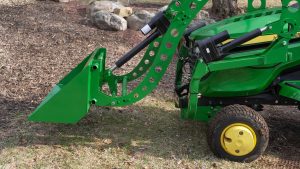
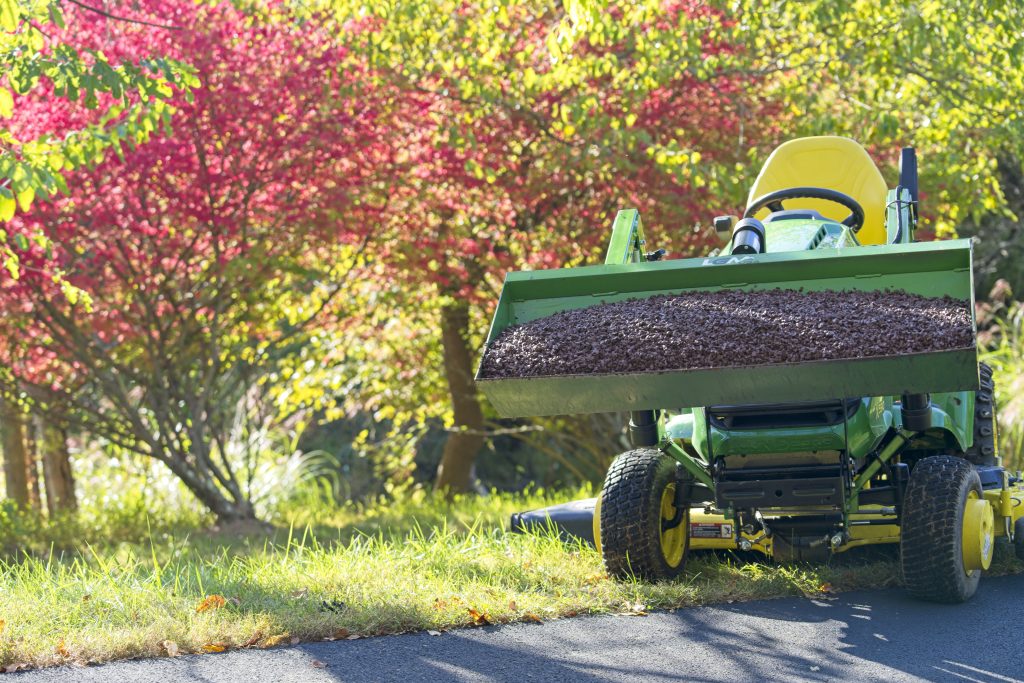
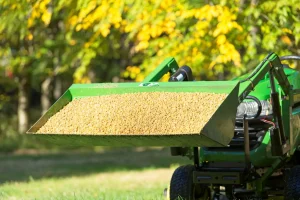
The first major task is mulch. If you have ever moved ten yards of mulch by hand, you know the drill. You shovel it into a wheelbarrow, wobble it across the lawn, dump it, and repeat fifty times. It’s exhausting. With your loader, you drive into the pile, scoop, and transport. The beauty of the LGM-100 is the precision. You aren’t dumping a massive bucket load from a skid steer that crushes your hydrangeas. You have a nimble, 42-inch bucket that fits right into those tight garden beds. You can gently tip the bucket to sprinkle mulch exactly where you need it, saving you raking time later.
Then there is the cleanup. Winter leaves behind a mess of fallen branches, wet leaves, and sometimes gravel that the snowplow pushed into the grass. Raking that heavy, wet debris into a tarp is a recipe for back spasms. We prefer to use the loader as a mobile dumpster. Park it right next to where you are working, load it up, and drive it to the compost pile.
We also can’t forget about seasonal equipment uses that people overlook, like managing topsoil. Spring rains wash out driveways and create low spots in the lawn. Fixing this by hand is miserable because topsoil is deceptively heavy. With your loader, you can scoop from your stockpile, drive to the low spot, and back-drag the bucket to level it out. That “back-drag” technique is a pro move, using the bottom edge of the bucket while reversing to smooth out the dirt like butter.
Once the grass is green, the real projects start. Summer is for hardscaping, driveway maintenance, and those “to-do” list items that involve moving heavy things from point A to point B.
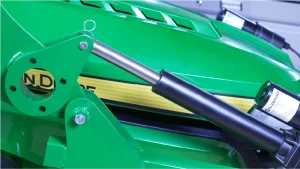
We talk to a lot of property owners who struggle with gravel driveways. Over time, gravel migrates. It gets pushed to the edges or sinks into the mud. You need to freshen it up. This is where the control of an electric actuator system really shines. Unlike hydraulics, which can sometimes be jerky if the fluid is hot or the valves are sticky, the electric actuators on the LGM-100 hold steady. You can scoop a load of fresh gravel and spread it in a thin, even layer by tilting the bucket just a fraction as you drive forward. It’s called “tailgating” in the dump truck world, and you can do a mini version of it right in your driveway.
Summer is also when you might be doing some light construction or landscaping upgrades. To save you some time, here is a quick checklist of the heavy materials we use our loader for the most during these months:
Another thing to consider is compost management. If you are serious about gardening, you have a compost pile. Turning that pile by hand with a pitchfork is hot, smelly work in July. We use the loader to dig into the pile, lift it high, and dump it back down. This introduces oxygen and speeds up the decomposition without you breaking a sweat. It turns a two-hour chore into a fifteen-minute joyride.
Fall is our favorite season, but it is also the deadline. You are racing against the first freeze. The biggest job for many of us is firewood. If you heat with wood, you know the struggle of moving rounds from the woods to the splitter, and then moving split wood to the stack.
The LGM-100 is a firewood beast. You can toss rounds directly into the bucket out in the woods. It saves you from carrying heavy oak or maple logs against your chest, which ruins your clothes and your back. Once you’ve split the wood, toss it back in the bucket to run it to your porch or woodshed. It turns the tractor into a workhorse. You aren’t just driving, you’re hauling.
Leaf management is the other massive fall headache. We’re not talking about a few leaves; we’re talking about that thick, wet mat of leaves that suffocates your grass. If you have a bagger on your mower, you know it fills up in thirty seconds. We like to use a blower to create massive piles, then use the loader to scoop them up. It’s surprisingly effective. You push the bucket into the pile, maybe use a rake to help pack it in, and haul massive amounts of leaves away in one go.
This is also the time to inspect your front-end loader for potential maintenance issues before it gets too cold. Check your bolts, clean off the summer dust, and make sure your battery is in top shape. Fall mud can be sticky, so keeping the bucket clean ensures you aren’t carrying around twenty pounds of dried clay for no reason.
A lot of people think the tractor hibernates in winter. They couldn’t be more wrong. In fact, this might be when you appreciate the LGM-100 the most.
Let’s talk about snow. If you get a light dusting, a blower is fine. But when you get that heavy, wet snow, or the plow leaves a three-foot wall of ice at the end of your driveway, a snowblower often chokes. A loader doesn’t choke. You can break down those snow banks, lift the snow, and pile it high. That “lift” capability is key. A plow blade pushes snow to the side, and eventually, you run out of room. With a loader, you can stack snow up and over, keeping your driveway wide and clear.
Here is a specific advantage of the electric system that we absolutely love: cold-weather performance. Hydraulic fluid hates the cold. It gets thick like molasses. You have to let a hydraulic tractor idle for twenty minutes to get the loader to move at a normal speed. If you have a hydraulic leak in winter, it’s a nightmare to fix frozen hoses. The LGM-100? It doesn’t care. The electric actuators work immediately. You turn the key, and you have full power. No warm-up, no sluggish controls. It’s ready when you are.
You can also use the loader to carry salt or sandbags. Instead of dragging a 50-pound bag of rock salt down the icy driveway, toss it in the bucket and drive it to where you need it. It’s safer and keeps you from slipping on the ice.
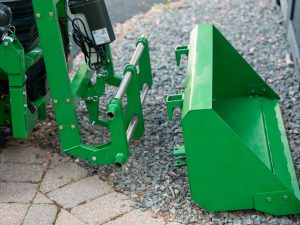
Now, we have to talk about the gear itself. When people look at upgrading their tractors, they often get confused by the options. One of the smartest front-end loader attachments you can invest in is simply the loader unit itself, like the LGM-100, because of what it adds to the base machine.
The standard bucket is your best friend, but think about how you use it. You can drill holes in the cutting edge to bolt on a plastic strip for snow removal so you don’t scratch your pavers. You can add clamp-on forks (if you’re careful about the weight) to move brush piles or pallets. The bucket is the universal adapter for your property.
Here are a few quick hacks we’ve seen smart owners use with their buckets:
It’s important to remember that the LGM-100 is designed for the homeowner. It fits the John Deere X300 and X500 series perfectly because it was engineered for them. It’s not a ‘one size fits all’ generic part. That integration means it balances correctly. When you have a bucket full of wet sand, you want to know the machine is stable.
Look, at the end of the day, owning a property involves work. There is no way around it. But you get to choose how hard that work is. You can be the person exhausted on the couch by 2:00 PM, or you can be the person who finished the chores by noon and still has energy to play with the kids or fire up the grill.
A front-end loader transforms your tractor from a seasonal mower into a four-season utility vehicle. It handles the mulch in spring, the stone in summer, the wood in fall, and the snow in winter. It doesn’t complain, it doesn’t get tired, and with the electric system on the LGM-100, it doesn’t leak oil on your driveway.
So, take a look at your garage. If that tractor is sitting there waiting for the grass to grow, you are missing out. Put it to work. Your back will thank you.
In spring, a front-end loader helps move bulk materials like mulch, compost, and topsoil efficiently. It also reduces physical strain by allowing easy transport of saplings, rocks, and flowers compared to manual tools like wheelbarrows.
During summer, a loader is useful for hauling gravel, repairing driveways, transporting firewood, and moving fencing materials. It acts as a versatile tool for both maintenance and property improvement projects.
In fall, a loader efficiently handles leaves, branches, and garden debris. It also helps move heavy seasonal items like hay bales and pumpkins while supporting yard cleanup and brush removal.
In winter, a loader can clear light snow from driveways and sidewalks, transport salt or sand for icy areas, and move firewood, making it a valuable snow and cold-weather management tool.
A front-end loader increases tractor usability throughout all seasons by replacing manual labor with mechanical efficiency, making it useful for landscaping, hauling, cleanup, and snow removal year-round.

© 2026 All Rights Reserved | LGM USA LLC
Added to cart
Check out our shop to see what's available