

You walked into the equipment store on Saturday morning to look at front-end loaders. You’ve got a John Deere X300 sitting in the garage and a yard that keeps giving you reasons to wish it could do more. Pile of mulch in the driveway. Firewood that needs to come up from the back of the lot. A flower bed your wife wants expanded by Mother’s Day.
You start scrolling through loader attachments online and the price gap hits you. One model is around a thousand bucks. Another costs significantly more. Then you start reading specs about high-flow hydraulics, AR400 wear plates, hardened cutting edges, and you start wondering if the cheaper one is going to fall apart on you.
Here’s the short version. A residential loader attachment built for your tractor will handle the real work you throw at it for years. Commercial gear solves a different problem, one most homeowners don’t have. The reasons that matter aren’t always the ones on the spec sheet.
Let’s walk through it.
A commercial loader attachment is built to take a beating. Not occasional weekend use. A real beating. Eight hours a day, five or six days a week, year after year. The people running those attachments are clearing land, prying out tree stumps, scooping concrete chunks, loading rock into dump trucks, and grading roads.
Everything about a commercial attachment is designed for that duty cycle. Heavier steel. Thicker mounting plates. Reinforced gussets in the corners. Bolt-on cutting edges you can flip and replace. Grease zerks at every pivot point so somebody running it daily can service the machine and keep it alive for thousands of hours.
That overbuilt design is the whole point. If you’re using the attachment that hard, you need it. The cost of a $5,000 attachment is nothing compared to the cost of one that fails on you in the middle of a long work day.
The thing is, none of that describes how you use your X300 in your backyard.
Think about what your loader actually does in a typical year on your property.
Add that up across the year and it is dozens of hours of real, weight-bearing work, often in tough conditions. A residential loader built for the X300 or X500 is engineered to handle exactly that pace, season after season.
That is not the duty cycle a commercial attachment is built for. A commercial unit is rated to run several thousand hours of hard use across its lifetime. Most homeowners will never come close to using the durability a commercial attachment is built for, which makes that extra cost hard to justify.
Mulch, dirt, gravel, snow, firewood, brush. A well-built residential loader handles all of that without breaking a sweat. The wear plates and hydraulic muscle on a commercial unit are answering a problem your weekend is not asking.
Here’s the part nobody at the equipment store will tell you. Most commercial loader attachments physically cannot bolt onto your John Deere X300 or X500 in the first place.
Commercial attachments are built for skid steers, compact track loaders, and full-size utility tractors. The mounting plates use the universal skid steer quick-attach system. Commercial attachments usually require mounting systems and hydraulic flow and pressure that an X300 or X500 does not have. Your lawn tractor doesn’t have that. Your lawn tractor was never designed to have that.
If you tried to bolt a commercial bucket onto an X300, two things would happen. First, the mount wouldn’t fit. Second, even if you somehow rigged it to fit, the bucket weighs more than your tractor’s front end can lift. Your X300 would never get the load off the ground. You’d be staring at an expensive piece of steel that just sits there.
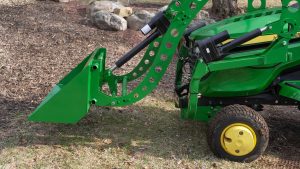
Residential loader attachments built for the X300 and X500 are right-sized for what your tractor can actually carry. They lift around 320 pounds. They run off a sealed electric actuator and a joystick instead of a hydraulic system. They bolt on with brackets engineered for your specific tractor. That is not a watered-down version of a commercial loader. It is a loader designed from the ground up for your machine and your kind of work.
Let’s actually do the math instead of guessing.
A residential loader lets you use the tractor you already own. You bolt it on the tractor you already own. You plug it into the battery. You’re moving mulch by Saturday afternoon.
A commercial setup looks different. You’d need a skid steer or a sub-compact tractor capable of handling the attachment. A commercial setup usually means stepping up to a different machine and heavier attachments, which is a much bigger investment than most homeowners need for occasional property work. Then you’re paying another three to five grand for each commercial attachment. Then you’ve got a second machine taking up half your garage that you’re going to use a few weekends a year.
For the homeowner with a backyard and a tractor he already owns, the math is not close. The residential answer wins by an order of magnitude.
If you want to dig into how an electric loader actually compares to the older hydraulic systems, the post on electric vs hydraulic loaders for homeowners walks through that side by side.
A lot of the differences between commercial and residential attachments are real engineering decisions, but they only matter if your workload demands them.
Take the steel grade. Commercial attachments use AR400 or AR500 wear plates because they’re scooping rock and concrete every single day. Your residential attachment is scooping mulch and gravel a few hours a week. The steel on a quality residential bucket is more than strong enough for years of mulch, gravel, dirt, and snow work. The wear plates on a commercial unit are answering a problem you do not have.
Same goes for the bolt-on reversible cutting edge. That’s there for the guy on a daily work routine who’s flipping the edge every other month because he’s grinding it down on pavement. You’re not going to wear through the cutting edge on your lawn tractor loader in your lifetime of weekend mulch runs.
Same goes for the high-flow hydraulics. Same goes for the heavy-tubular frame. Same goes for the grease zerks at every pivot. They’re solving problems that come from heavy daily use. You don’t have heavy daily use. You have a Saturday morning and a list of things to get done before the game comes on.
Spec sheets reward overbuilt gear because that is what sells in commercial channels. For your yard, the smarter buy is gear that matches the work, not gear built for someone else’s job.
A residential loader attachment built for your specific tractor gets you a few things commercial gear can’t.
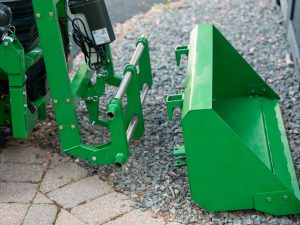
It actually fits. The brackets are designed for your X300 or X500 specifically. No fabricating mounts. No worrying about whether the front end can carry the weight. You bolt it on, it sits where it should, and your tractor still drives the way it always did.
It’s something you can install yourself in an afternoon. No shop visit. No paid installer. The bolts go where the bolts go and you’re done before dinner. If you can change a tire, you can install a residential front-end loader.
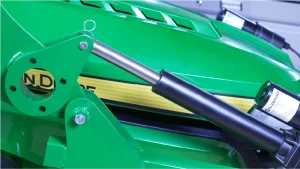
It uses an electric actuator instead of a hydraulic pump. That means no hydraulic fluid to leak, no high-pressure hoses to crack, no dealership trip when something goes wrong. A bad actuator unbolts and the new one bolts back on. You can do it in your driveway with hand tools.
It’s quieter. It’s lighter. It doesn’t beat up your tractor’s frame the way a heavy commercial bucket would. And when you’re done with it for the season, you can lift it off and store it on a shelf in the garage if you want the front end clear for a snow blade or a different attachment.
It is sized for real loads. Around 320 pounds is the right number for a scoop of mulch, a stack of firewood, a load of gravel, or a bucket of topsoil. It is enough lift to do real work, and it is balanced so it does not push the tractor past what it was built to handle. Lift capacity that matches the chassis is more useful than raw capacity the chassis can’t actually use.
The whole package is built around a homeowner who uses his tractor on his own property and expects it to keep working. That is not a smaller version of commercial gear. It is a different category of tool, designed for a different kind of life, and built to last in that life.
If you want a deeper look at what a residential loader can actually pull off in real-world use, the post on whether an electric front-end loader is powerful enough for home projects covers the use cases.
To be fair, commercial loader attachments exist for a reason. There are people who genuinely need them.
If that’s you, commercial gear pays for itself in a year. The overbuilt steel and the serviceable design are answering real problems you have.
If that’s not you, and you’re a homeowner with a lawn tractor and a yard you take pride in, commercial is the wrong shelf. You’d be paying for capacity you’ll never touch.
Here’s a gut-check before you swipe the card on anything.
Ask yourself three questions.
One. What’s the tractor I’m putting it on?
If it’s a John Deere X300 or X500 lawn tractor, you’re looking at residential attachments. Period. Commercial gear isn’t built to mount on a lawn tractor and your tractor isn’t built to lift it.
Two. How many hours a week am I really going to use this?
If the answer is under ten hours a week on a regular basis, residential is your tier. If you’re looking at thirty-plus hours a week of hard use, that’s when you start thinking about commercial duty cycles.
Three. What’s the worst material I’ll actually scoop?
If the worst case is mulch, dirt, gravel, firewood, or snow, residential is built for that. If you’re regularly scooping busted concrete, jagged rock, or heavy clay loaded with construction debris, that’s commercial territory.
For most homeowners with an X300 or X500, all three answers point to residential. That is not a compromise. That is the right tool for the work you actually do.
A commercial loader attachment is a brilliant piece of equipment for the work it was built for, which is not your yard.
The right answer for an X300 or X500 owner is a residential electric front-end loader engineered for your tractor. It fits. It lifts real loads. It runs off your battery. It bolts onto your tractor without major modification. It is built to do the work for years.
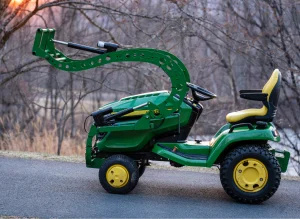
The LGM-100 is built for exactly this. Designed specifically for the X300 and X500. Around 320 pounds of lift. Electric actuator. Joystick control. Bolts onto the tractor sitting in your garage right now.
Your tractor can do more than cut grass. Make it actually useful.
Residential loaders are built to balance strength with a lightweight design so they can operate safely on smaller garden tractors. Commercial loaders use heavier steel and reinforced frames to withstand continuous, high-impact industrial use.
Commercial loaders typically use high-pressure hydraulic systems for fast, continuous operation. Residential models often use electric linear actuators, offering a cleaner and simpler plug-and-play solution without hydraulic fluid maintenance.
Homeowners frequently switch between multiple attachments in a single day, so residential loaders are designed with quick-release pins and simple connections. Commercial systems are usually more permanent and may require tools or assistance for changes.
Commercial loaders require regular hydraulic maintenance, including fluid changes, hose inspections, and seal replacements. Residential loaders need far less upkeep, typically limited to lubrication and basic electrical connection checks.
Commercial loaders have higher upfront and maintenance costs due to complex hydraulic systems and heavy-duty construction. Residential loaders are more affordable and cost-effective for homeowners managing property maintenance tasks.


© 2026 All Rights Reserved | LGM USA LLC
Added to cart
Check out our shop to see what's available