
You know the feeling. It’s Saturday morning, the coffee is still hot in the travel mug, and you’re looking at a pile of mulch or a stack of firewood that needs to be moved from Point A to Point B. You look at your lawn tractor, then back at the pile. You think, “She can handle it.”
But can she?
One of the most common mistakes homeowners make is judging capacity by engine power instead of frame strength, traction, and drivetrain limits, so we’ve learned that load capacity is the most misunderstood concept in the driveway. Most folks assume that if the engine runs, the wheels will turn. But physics doesn’t care about horsepower. It cares about axles, frames, and friction.
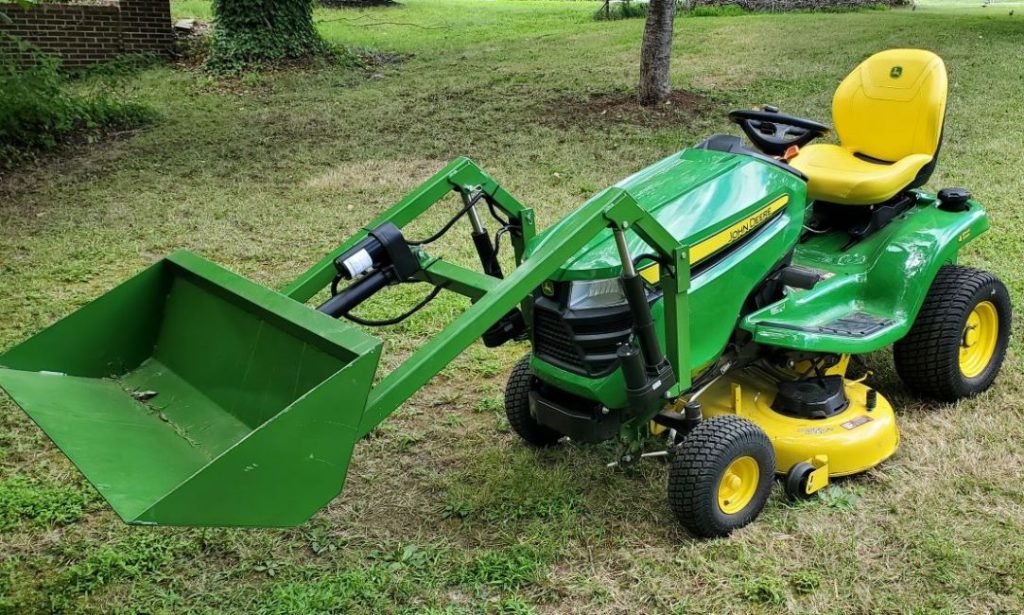
Since you’re here at LGM USA, you likely own a machine capable of real work, maybe a John Deere X300 or X500 series, and you might even be eyeing our LGM-100 front-end loader. That means you’re moving from “just cutting grass” to “actually using your tractor for projects.” That’s a big jump. To do it right, and to keep that machine out of the repair shop, you need to understand the basics of weight.
Let’s clear up the confusion around lawn tractor load capacity and get into what you can actually get away with.
First off, we have to stop using “weight” as a catch-all term. Your tractor interacts with weight in three very different ways, and each puts stress on a different part of the machine.
Most manufacturers are cagey about these numbers. You’ll find tow-behind accessories everywhere, but you rarely see a sticker on the dashboard that says, “Do not exceed 500 lbs.” That’s because the answer depends heavily on where you are driving.
If you take nothing else away from this guide, remember there is no one-number towing rule. It’s the industry standard rule of thumb for a reason. Generally speaking, there is no one-number towing limit that fits every tractor; start with your owner’s manual, then reduce the load further for hills, loose ground, wet material, and heavy tongue weight (plus the operator) on level ground.
Let’s do the math on a typical setup. Say you have a garden tractor that weighs roughly 600 lbs. You add your own 200 lbs to the seat. That’s an 800 lb total package. Using the 50% rule, you’re looking at a safe towing limit of around 400 lbs.
Now, does that mean the transmission will explode if you pull 401 lbs? No. But this brings us to the most common question we get: how much weight can a lawn tractor pull before things go south?
The answer lies in the transmission. If you have a manual gear-drive tractor, you have a bit more leeway because gears are tough. But most modern machines, including the John Deere X-series, use hydrostatic transmissions (like the Tuff Torq K46 or K58). These run on fluid pressure. When you tow a load that is too heavy, the fluid gets hot (really hot). Over time, that heat breaks down the oil, the pump loses pressure, and suddenly your tractor struggles to climb a gentle slope.
If you hook up a cart filled with wet sand (which is deceptively heavy, by the way), you aren’t just pulling weight, you are asking your hydraulic pump to work overtime. If you hear a high-pitched whine that gets louder as you accelerate, that is your tractor screaming for mercy.
Here is where the manual goes out the window. All those capacity numbers assume you are driving on a putting green. Flat, dry, and manicured.
As soon as you introduce a slope, the game changes. Gravity is a harsh mistress. Even a moderate hill can make a load much harder to pull, stop, and control than it feels on flat ground. Going down that hill is even more dangerous.
We remember a homeowner a few years back who loaded a utility cart with field stones from a project at the edge of his yard. He was well within the weight limit for pulling on flat ground. But his property had a steep drop-off near the creek. He started down the hill, hit the brakes, and nothing happened. The weight of the trailer pushed the tractor’s rear tires into a skid. He jackknifed and ended up in the bushes.
This is why lawn tractor towing capacity isn’t just a number. It’s a calculation of traction. Your brakes are on the rear wheels. If the trailer pushes the rear end around, you have zero control. For safety, if you have hills, cut that 50% Rule in half again.
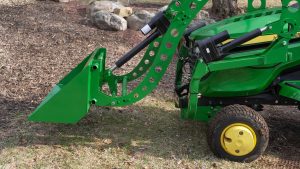
At LGM USA, we specialize in front-end loaders. This changes physics entirely. When you install an LGM-100 on your John Deere, you aren’t just towing. You are lifting. Our safety essentials guide for garden tractor front-end loader attachments walks through more of what to watch for.
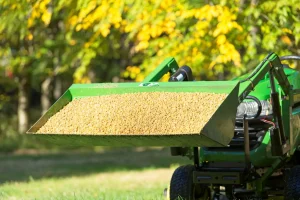
Our loader has a max lift capacity of about 320 lbs. That is a serious amount of weight for a residential lawn tractor. When you scoop up 320 lbs of mulch or topsoil, that weight sits primarily on the front axle. This is why we stress compatibility with the X300 and X500 series. These machines have frames built to handle that stress.
Physics demands balance. This is where ballast comes in.
You cannot lift 320 lbs out front without putting weight on the back. It’s the teeter-totter principle. Without rear ballast (like wheel weights or a weight box), lifting a heavy load can make your rear tires lose traction. Worst case, the rear wheels lift off the ground.
When you calculate your total load, you have to add it all up:
Your axles are bearing all of this. The good news is that the X300 and X500 series are tough machines. They are designed to work. But you need to be mindful of dynamic loads. A 320 lb load sitting still is fine. That same load bouncing over a tree root at 5 mph creates a shockwave of force that can crack metal.
We talk a lot about engines and transmissions, but let’s talk about rubber. Your tires are the only thing connecting your load to the earth.
Standard turf tires are great for not tearing up the grass, but they have flexible sidewalls. When you max out your load capacity, those sidewalls bulge. If you are doing heavy loader work or heavy towing, check your tire pressure. Check tire condition and inflation before loader or towing work, and stay within the tire’s rated pressure limits for the job to prevent the tire from rolling off the rim during a turn.
Also, consider traction. If you are using the LGM-100 to move snow or wet mulch, turf tires might spin. Chains or more aggressive lug tires can help transmit that power to the ground without stressing the differential. Our X300 and X500 chains vs. weights traction guide goes deeper on which option fits your yard.
Since you don’t have a scale in your backyard, you need to drive by feel. Here are the warning signs that you need to lighten the load:
This is a distinction that gets blurred, but it matters. Generally, a Lawn Tractor (like the lower-end big box store models) has a lighter transmission (K46). The X500 series is generally built heavier than the X300 series, but exact drivetrain features vary by model.
The LGM-100 is designed to work with both the X300 (lawn tractor class) and X500 (garden tractor class). However, if you are on an X300, you need to be more conscious of your limits. You can absolutely move mulch, soil, and firewood. Just don’t try to use the loader as a battering ram for things it wasn’t built for. The X500 owners have a little more muscle to play with on heavier ground engagement.
Your tractor is a tool, not a toy. It can do amazing things, especially with an LGM-100 loader attached. A homeowner with a couple acres can knock out a yard or two of mulch over a Saturday, push snow off the driveway in a fraction of the time it takes to shovel, or move firewood from the back of the property up to the porch without breaking their back. The key is respect.
Respect the slope. Respect the transmission. And respect the weight limits.
If you treat your machine right (keeping loads reasonable, using ballast, and driving slow over bumps), it will last you a lifetime. Push it beyond its limits, and you’ll be spending your weekends on repairs instead of projects.
So go ahead and tackle that pile of gravel. Take it in three loads instead of one. Your tractor will thank you.
The safe load capacity depends on the tractor’s frame strength, front axle rating, and tire pressure. Exceeding these limits can cause structural damage, instability, or transaxle failure, so manufacturer guidelines should always be followed.
A front-end loader shifts the center of gravity forward and higher, reducing stability. Keeping loads low during transport is essential to minimize tipping risks, especially on slopes or uneven terrain.
Rear counterweights balance the load by shifting weight back toward the rear axle. This improves traction, stabilizes the tractor, and reduces stress on the front axle and tires when carrying heavy loads.
Proper tire pressure ensures the tractor can support heavy loads without buckling or rim damage. Well-maintained, correctly inflated tires provide stability and reduce the risk of slippage or structural strain.
Signs of overload include heavy steering, visibly compressed front tires, and reduced rear traction. These indicate excessive strain on the machine and increased risk of mechanical failure or instability.

© 2026 All Rights Reserved | LGM USA LLC
Added to cart
Check out our shop to see what's available